भारत का सबसे भयानक ट्रेन हादसा! India’s Deadliest Train Crash ! True Story of Train Accident
.
.
.
India’s Deadliest Train Crash: The True Story of the Firozabad Disaster
When asked what is more valuable—human life or money—most people answer without hesitation: life. But history shows that when this question confronts large systems, especially bureaucratic ones, the answer often changes. Budgets are examined, files are reviewed, costs are calculated, and decisions are postponed. The price of those delays is sometimes paid not in currency, but in human lives.
On the night of August 20, 1995, this grim reality unfolded in Firozabad, Uttar Pradesh, in what would become one of the deadliest train accidents in Indian railway history. Hundreds of people died in their sleep, and the tragedy was officially labeled an “accident” caused by “human error.” Yet, decades later, the deeper question remains unanswered: When humans make mistakes, what is the responsibility of the system meant to protect them?
A Quiet Night Before Disaster
Firozabad was asleep.
The streets were empty, homes were silent, and darkness covered the railway tracks stretching across the town. At around 2:30 a.m., the Kalindi Express, carrying more than 900 passengers, was slowly moving ahead after crossing Firozabad station.
Inside the train were migrant workers, soldiers returning home on leave, families, elderly passengers, children, and athletes traveling back from training camps. Everyone had a destination. No one imagined that within minutes, their lives—or the lives of their loved ones—would come to an abrupt end.
At that time, India’s railway system lacked modern safety technologies. There were no GPS-based warnings, no automatic collision prevention systems, and no centralized digital monitoring. Train drivers relied largely on signals, experience, and human judgment.
That night, fate took a cruel turn.
The First Trigger: A Nilgai on the Tracks
As the Kalindi Express moved forward in darkness, a nilgai (a large antelope) suddenly appeared on the tracks. The driver applied the brakes, but the train struck the animal. The collision itself was not catastrophic—but it was enough to damage the vacuum braking system.
Under the railway protocol of that era, when a vacuum pipe broke, the train would automatically come to a halt. That is exactly what happened.
The Kalindi Express stopped abruptly near the outer signal of Firozabad station, stranded in the dark—neither at the platform nor fully cleared from the main line.
From this moment onward, a deadly chain of negligence began.
Rules That Were Not Followed
Indian Railway rules were clear:
The driver must immediately inform the control room.
The guard must walk back along the tracks and place red warning signals to alert any approaching train.
Station authorities must confirm track clearance before allowing another train to proceed.
That night, none of these safeguards were fully implemented.
The driver got down to inspect the damage and attempted to fix the pipe. He assumed that someone else would inform the authorities. The guard did not go back far enough to place warning signals. The train remained stationary, invisible in the darkness.
This assumption—that “someone else will take care of it”—proved fatal.
The Signal Cabin That Never Looked Outside
At the west cabin of Firozabad station, 54-year-old switchman Gorelal was on duty. He had spent decades working in that cramped signal cabin, handling dozens of trains daily. Routine had become his greatest enemy.
Had he looked out of the window, he would have clearly seen the rear of the Kalindi Express and its red tail lamp glowing in the dark. But he didn’t.
Instead, he relied on panel lights, which failed to reflect the true position of the train on the track.
Meanwhile, the Assistant Station Master (ASM) prepared to allow the next train—the Purushottam Express—to pass.
According to rules, confirmation should have been taken from the previous station that the Kalindi Express had cleared the section. That confirmation never came. The line was cleared based on assumption, not verification.
When the ASM asked whether the line was clear, the switchman said yes.
That single word—yes—sealed the fate of hundreds.
The Final Blow: Ignoring the Yellow Signal
The Purushottam Express was now approaching at high speed.
Its driver saw a yellow signal, which means caution—slow down, the track ahead may not be clear. But railway culture at the time discouraged slowing down unless absolutely necessary. Delays led to questioning and disciplinary action, while caution often went unnoticed.
Assuming the next signal would turn green, the driver maintained speed—nearly 100 km/h.
Seconds later, the headlights illuminated something unthinkable.
A train.
Stationary.
Directly ahead.
The emergency brakes were applied—but physics has no mercy. A train traveling at that speed cannot stop instantly.
The Purushottam Express slammed into the Kalindi Express from behind.
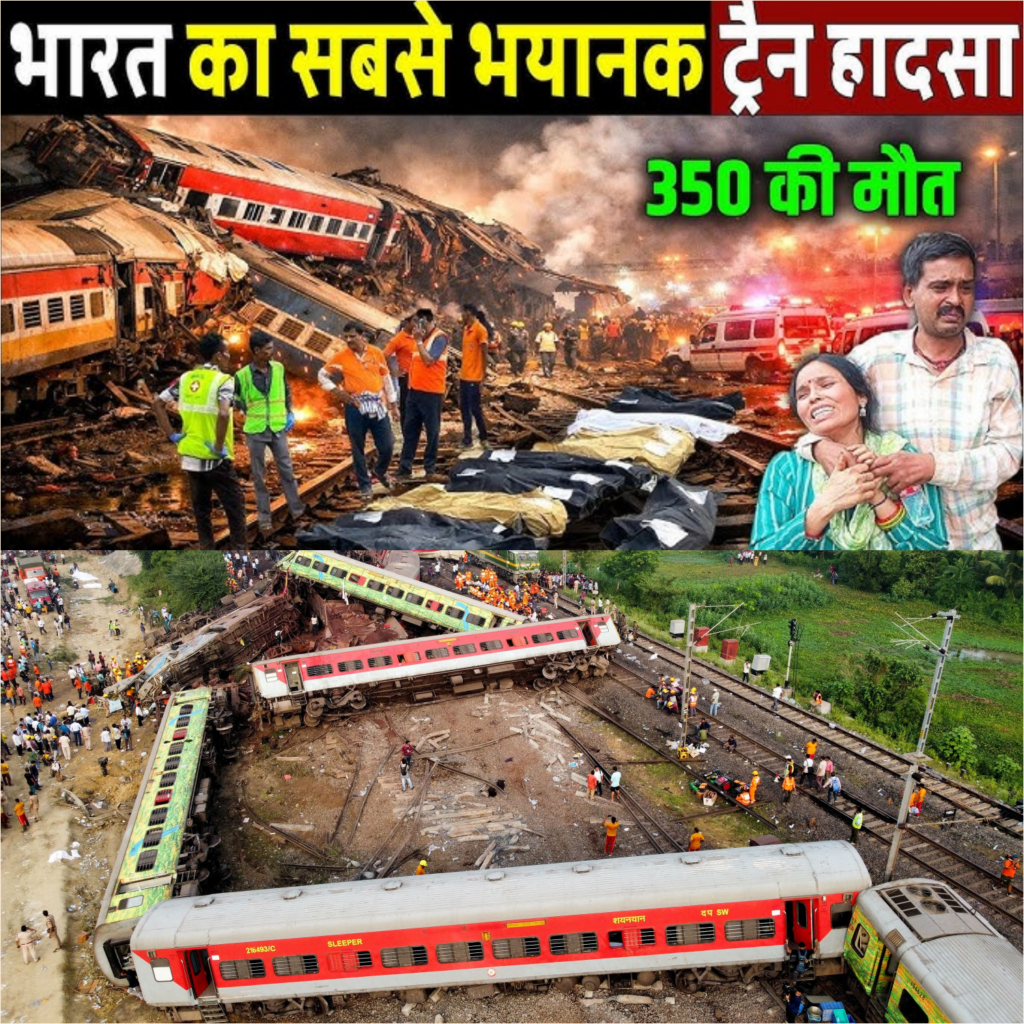
A Scene of Unimaginable Horror
The impact was catastrophic.
Coaches climbed over one another. Metal twisted like paper. Screams replaced silence. Lives ended instantly. Others were trapped, crushed, or burned.
When dawn arrived, the scene was beyond comprehension.
Bodies lay scattered among mangled coaches. Limbs severed. Faces unrecognizable. Blood stained the tracks red.
Rescue workers used gas cutters to tear through metal. Torches flickered in the darkness as bodies were pulled out—many beyond recognition.
Among the dead were:
Indian Army soldiers returning home on leave
Athletes traveling from training camps
Workers, parents, children, and elderly passengers
Some carried gifts for family members. Others had medicines for loved ones waiting at home.
By official counts, over 300 people were killed, making it one of India’s worst train disasters.
Blame Without Accountability
An inquiry was ordered immediately.
The conclusion was swift and predictable:
Driver negligence
Switchman error
Station master failure
Human error.
Case closed.
But the deeper questions were never seriously addressed.
Why was a major junction like Firozabad operating with outdated signaling systems?
Why were automatic track circuits—which prevent green signals if a train is still on the line—not installed?
Why were staff members overworked, understaffed, and dependent on unreliable equipment?
The answers were buried in files.
The File That Could Have Saved Lives
Months before the accident, a proposal had been submitted to the Railway Board. It clearly warned that the Delhi–Kanpur section, including Firozabad, had become extremely dangerous due to increasing traffic and outdated systems.
The solution was simple: install modern automatic signaling and track detection systems.
The cost?
Several crores of rupees.
The decision written on the file was just two words:
“Unnecessary expenditure.”
That decision cost hundreds of lives.
When Humans Are Expected to Be Machines
Switchman Gorelal handled over 60 trains a day, confined to a small cabin with no proper ventilation, rest, or modern tools. He was expected to function with machine-level accuracy—despite being human.
In countries with automated systems, even if a human makes a mistake, the system prevents disaster. In India at the time, human error was the system.
And when that system failed, it blamed the weakest individuals.
Aftermath: Compensation and Silence
Compensation was announced. Files were closed.
Families received money—but no answers.
Mothers lost sons. Children lost fathers. Wives lost husbands.
For the railway system, life moved on.
For the families, time stopped.
A Warning Written in Blood
The Firozabad crash was not just an accident. It was a consequence of deliberate neglect, postponed decisions, and misplaced priorities.
Every safety system introduced later—whether automatic signaling or collision prevention—came at the cost of lives already lost.
The tragedy forces a question that still haunts India’s infrastructure today:
Is saving money worth risking human lives?
If spending a few crores could have saved 300 people, then this was not merely a disaster—it was a decision.
And until systems choose safety before tragedy, not after it, the tracks will continue to carry not just trains—but warnings written in blood.
News

Doktorlar mafya babasının kısır olduğunu söyledi—bir garson ondan hamile olduğunu söyleyene kadar.
Doktorlar mafya babasının kısır olduğunu söyledi—bir garson ondan hamile olduğunu söyleyene kadar. . . . Chicago’nun karanlık ve acımasız yeraltı…
Tarihin En Acımasız Emri: 15.000 Esir Askeri Kör Edip Geri Gönderdi
Tarihin En Acımasız Emri: 15.000 Esir Askeri Kör Edip Geri Gönderdi . . . Karanlığın Yürüyüşü: Bir İmparatorun Soğuk Zaferi…

Köle Kadından Doğan Beyaz Çocuklar, Koca Bir Plantasyonu Nasıl Çökertti?
Köle Kadından Doğan Beyaz Çocuklar, Koca Bir Plantasyonu Nasıl Çökertti? . Köle Kadından Doğan Beyaz Çocuklar: Blackwood’un Çöküşü Güneyin yaz…
Bilim İnsanlarını Şaşkına Çeviren Çocuk: Elias’ın Vakası
Bilim İnsanlarını Şaşkına Çeviren Çocuk: Elias’ın Vakası . . . Bilim İnsanlarını Şaşkına Çeviren Çocuk: Elias’ın Vakası 1972 yılının dondurucu…
1997’de Sarıçöl’de Kaybolan Selim Karabey – 16 Yıl Sonra Bulunan Mataranın Sakladığı Gizemler
1997’de Sarıçöl’de Kaybolan Selim Karabey – 16 Yıl Sonra Bulunan Mataranın Sakladığı Gizemler . . . 1997’DE SARIÇÖL’DE KAYBOLAN SELİM…
Sıradan Bir Tokat, 20 Yıllık Sırrı Ortaya Çıkardı: O Adam Geri Döndü!
Sıradan Bir Tokat, 20 Yıllık Sırrı Ortaya Çıkardı: O Adam Geri Döndü! . . . Sıradan Bir Tokat, 20 Yıllık…
End of content
No more pages to load