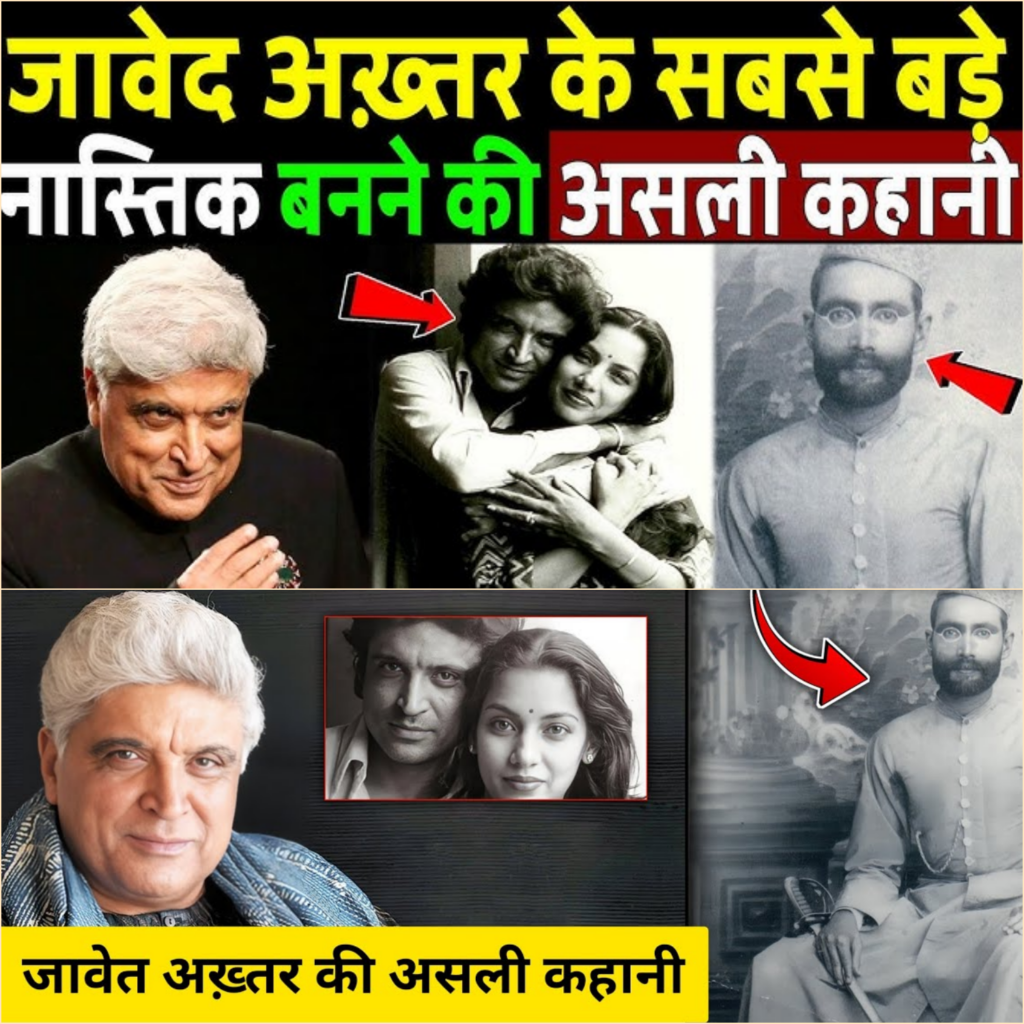
जावेद अख़्तर के सबसे बड़े नास्तिक बनने की असली कहानी । Real History of Javed Akhtar
.
.
.
A public atheist in a deeply religious society
India is home to extraordinary religious diversity, and also to intense religious feeling. In such a society, atheism is not merely a private belief; it becomes a cultural statement—sometimes even a perceived challenge. Javed Akhtar is among the best-known Indian public figures who identifies as an atheist and says so plainly.
His atheism is not presented by him as fashionable contrarianism. It is usually framed as:
A preference for evidence over faith
A rejection of organized religion as a moral necessity
A humanist argument: good conduct should be rooted in empathy, ethics, and social responsibility rather than divine command
That stance, voiced repeatedly in interviews and public events over decades, places him in a familiar intellectual tradition: writers and public thinkers who argue that being ethical is a human duty, not a religious requirement.
Early life: literature, loss, and independence of mind
Javed Akhtar was born on 17 January 1945 in Gwalior, in what is now Madhya Pradesh. His parents were not ordinary middle-class figures. His father, Jan Nisar Akhtar, was a respected Urdu poet. His mother, Safia Akhtar, was an educated woman associated with writing and teaching.
A household shaped by poetry and literature tends to nurture a particular kind of attention:
attention to language
attention to argument
attention to nuance
and, crucially, comfort with questioning
But public narratives about Akhtar’s childhood also frequently highlight a different theme: early emotional hardship, especially the loss of his mother at a young age and the experience of growing up with emotional distance and instability. Without leaning into melodrama, it is worth noting a general truth: early loss often pushes people toward one of two directions—
deeper reliance on faith and the comfort of divine purpose, or
deeper skepticism, shaped by the sense that life can be painfully arbitrary
Many of Akhtar’s later arguments—especially about suffering, injustice, and the moral silence of the universe—sound closer to the second path: a worldview where the universe offers no guaranteed justice, which makes human responsibility more urgent, not less.
Bhopal and the pull of the wider world
Parts of Akhtar’s early education and young adulthood are associated with Bhopal, where he studied and began imagining a future in film. Like many ambitious young people outside major industry hubs, he eventually confronted a practical reality: to work in Hindi cinema at scale, you needed to be in Bombay (Mumbai).
The move to Mumbai, described in many accounts as a period of severe struggle, is a key chapter in the “why” behind his worldview. Big cities can intensify faith—but they can also intensify realism. When you face:
unstable income
uncertain housing
professional rejection
social isolation
you often learn, quickly and sharply, how much of life depends on systems and chance rather than cosmic design.
Akhtar’s public persona later carries the stamp of that experience: he speaks like someone who believes the world is improved not by prayer alone, but by institutions, law, education, and civic ethics—things humans must build and maintain.
The Salim–Javed years: writing power, anger, and the system
Akhtar’s arrival into mainstream recognition is inseparable from his partnership with Salim Khan, forming the iconic screenwriting team Salim–Javed. Their scripts—associated with films that became landmarks in popular cinema—reshaped the tone of Hindi film storytelling.
What’s relevant to the topic of atheism is not gossip about the industry, but the moral architecture visible in that era’s storytelling:
the individual versus a corrupt system
anger as a response to injustice
power structures (money, crime, political influence) as human-made forces
salvation, when it appears, coming through courage, solidarity, or moral clarity—not through miracles
A writer doesn’t need to be an atheist to write such stories. But a repeated emphasis on human agency, institutional failure, and the ethics of resistance often aligns with a worldview where “fate” is not an acceptable explanation for suffering.
Over time, Akhtar also became increasingly prominent as a poet and lyricist, writing songs across decades. Even without quoting lyrics (which would be copyrighted), it is safe to say that his body of work helped define the emotional register of modern Hindi film music—appearing in films such as Dil Chahta Hai, Kal Ho Naa Ho, and many more.
Personal life and public identity: raising children beyond religious boundaries
Akhtar’s personal life is widely known in outline: he married Honey Irani and they had two children, Farhan Akhtar and Zoya Akhtar. The marriage later ended in divorce, and he married Shabana Azmi, one of India’s most respected actors and public intellectuals.
Online narratives often latch onto one particular claim: that he did not raise his children “according to Islam.” It is more precise to frame this as a broader principle he has voiced publicly: he did not want upbringing to be governed by religious identity, but by ethical and humanistic values.
That approach is not rare among writers and artists, especially those shaped by plural environments. But in a society where religion often functions as family heritage, community belonging, and personal meaning, it becomes controversial—particularly when expressed bluntly.
A striking contrast: religious ancestry and an atheist descendant
One reason his atheism is repeatedly framed as “surprising” is his family lineage, which includes prominent figures in Urdu literature and Islamic scholarship. Public accounts frequently mention ancestors associated with religious learning and political involvement in the 19th century.
Whether or not every popular online detail is reliable, the larger point remains: Akhtar comes from a line where faith, scholarship, and intellectual authority were culturally significant. His atheism, then, is not a simple “rejection of roots” in the shallow sense; it is closer to a modern argument that:
moral seriousness can exist without theology
identity can be cultural without being doctrinal
tradition can be honored as history, without being treated as unquestionable truth
This is a key nuance often lost in polarizing content: an atheist from a religious background is not necessarily rejecting family or culture. Sometimes they are rejecting certainty, especially certainty that discourages questioning.
What his atheism sounds like: evidence, suffering, and moral accountability
Across public appearances and debates, Akhtar’s atheism typically includes three recurring themes:
1) Evidence over belief
He has repeatedly argued that belief should not be demanded without proof. In philosophical terms, this is a rationalist stance: claims about reality require justification proportional to the claim.
This doesn’t “disprove” God. It simply places the burden of proof on those making a metaphysical assertion and treats faith as a personal choice rather than a public requirement.
2) The problem of suffering
Akhtar often points to human suffering—particularly suffering of innocents—as a challenge to the idea of an all-powerful, all-good deity who is actively governing events.
This argument is ancient (found in multiple philosophical traditions), but it remains emotionally powerful when tied to contemporary tragedies. The logic, in simplified form, goes like this:
If a benevolent and omnipotent God exists and intervenes, why do mass atrocities and the suffering of children occur?
If God exists but does not intervene, what practical difference does that make to victims?
If God is invoked to justify suffering as “divine will,” does that reduce human responsibility to prevent suffering?
This is not a “winning line” in a debate so much as a moral challenge: it demands that believers articulate how they reconcile divine goodness with worldly horror.
3) Humanism: good without God
Akhtar is often associated with the claim that being a good person does not require religion; it requires insaniyat—humanity. This is a classic humanist principle:
ethics can be grounded in empathy
justice can be pursued through law and social reform
dignity can be defended without divine command
Again, it is important to state this carefully: humanism does not automatically negate religion. Many believers are humanists. But Akhtar’s point, as commonly expressed, is that religion is not a prerequisite for moral behavior.
Why these views trigger intense backlash
Akhtar’s atheism provokes strong reactions for several reasons:
Public atheism disrupts social harmony in communities where religious belief is assumed as default.
His identity is frequently read through religious labels, so his disbelief is treated by some as betrayal rather than personal philosophy.
His tone is direct, and directness about religion is often interpreted as disrespect even when it’s framed as critique rather than insult.
Social media amplifies conflict, extracting sharp lines from long discussions and turning philosophical disagreement into tribal competition.
In short: he is not only an atheist—he is an atheist with a microphone, cultural authority, and rhetorical skill. That combination makes him a lightning rod.
The “debate moment” problem: how virality distorts meaning
The script-like content that circulates online often frames his atheism as the product of a single debate, a single quote, or a single rhetorical comparison involving political leadership and divinity. These frames usually miss two realities:
-
A worldview takes decades to form.
Akhtar’s atheism is not new, and it is not plausibly the result of one event. It appears as a consistent public stance across many years.
Debates contain rhetoric.
In live debates, participants use sharp contrasts, irony, and provocation. Treating every line as a literal doctrinal statement flattens the purpose of debate, which is often to stress-test ideas, not to write scripture.
A more honest interpretation is: his public comments fit a broader pattern—skepticism, moral outrage at suffering, and insistence on human responsibility.
What we can responsibly say—and what we should avoid
Because online “real history” videos frequently blend truth with exaggeration, it’s worth drawing a boundary between responsible biography and clickbait storytelling.
Reasonable, widely accepted basics:
Javed Akhtar is a major Indian poet, lyricist, and screenwriter.
He was born in 1945; his father was Jan Nisar Akhtar.
He is publicly and explicitly atheist/agnostic in outlook.
He has argued that morality does not require religion and that claims about God should meet standards of evidence.
He has participated in public discussions and debates about religion and atheism.
Things that require caution:
Claims that reduce his atheism to one “secret reason”
Oversimplified “he left Islam on X date” narratives
Viral quotes presented without context
Assertions about how his children were raised stated as if they are proven facts rather than broad principles and public remarks
A serious account avoids turning complex intellectual development into a single sensational turning point.
A clearer conclusion: atheism as temperament, not headline
If you want to understand why Javed Akhtar became one of India’s most famous atheists, it helps to see the arc rather than the clip:
a childhood shaped by literature and early hardship
a youth with ambition that demanded independence
a Mumbai period that likely intensified realism and self-reliance
an artistic career built on human conflict, social critique, and institutional failure
a public voice that values evidence, questions inherited certainty, and insists that morality is a human project
Whether one agrees with him or not, his atheism is best understood not as a provocation but as a philosophical posture: a refusal to outsource ethics to the heavens, and a demand that humans take full ownership of what happens on earth.
News

Doktorlar mafya babasının kısır olduğunu söyledi—bir garson ondan hamile olduğunu söyleyene kadar.
Doktorlar mafya babasının kısır olduğunu söyledi—bir garson ondan hamile olduğunu söyleyene kadar. . . . Chicago’nun karanlık ve acımasız yeraltı…

Tarihin En Acımasız Emri: 15.000 Esir Askeri Kör Edip Geri Gönderdi
Tarihin En Acımasız Emri: 15.000 Esir Askeri Kör Edip Geri Gönderdi . . . Karanlığın Yürüyüşü: Bir İmparatorun Soğuk Zaferi…

Köle Kadından Doğan Beyaz Çocuklar, Koca Bir Plantasyonu Nasıl Çökertti?
Köle Kadından Doğan Beyaz Çocuklar, Koca Bir Plantasyonu Nasıl Çökertti? . Köle Kadından Doğan Beyaz Çocuklar: Blackwood’un Çöküşü Güneyin yaz…

Bilim İnsanlarını Şaşkına Çeviren Çocuk: Elias’ın Vakası
Bilim İnsanlarını Şaşkına Çeviren Çocuk: Elias’ın Vakası . . . Bilim İnsanlarını Şaşkına Çeviren Çocuk: Elias’ın Vakası 1972 yılının dondurucu…

1997’de Sarıçöl’de Kaybolan Selim Karabey – 16 Yıl Sonra Bulunan Mataranın Sakladığı Gizemler
1997’de Sarıçöl’de Kaybolan Selim Karabey – 16 Yıl Sonra Bulunan Mataranın Sakladığı Gizemler . . . 1997’DE SARIÇÖL’DE KAYBOLAN SELİM…
Sıradan Bir Tokat, 20 Yıllık Sırrı Ortaya Çıkardı: O Adam Geri Döndü!
Sıradan Bir Tokat, 20 Yıllık Sırrı Ortaya Çıkardı: O Adam Geri Döndü! . . . Sıradan Bir Tokat, 20 Yıllık…
End of content
No more pages to load