दहेज मांगा तो दुल्हन ने लौटाई बारात, फिर जो हुआ इंसानियत हिल गई | Emotional story
.
.
When Dowry Was Demanded, the Bride Returned the Groom’s Party — And What Happened Next Shook Everyone’s Soul
There is a saying: gold is not judged by its shine but by the test it endures. Similarly, the true worth of a person is not measured by their wealth but by their self-respect and honesty. Today’s story takes us to a wedding mandap where the joyous sound of shehnai suddenly stopped. Where a demand for dowry was openly made, and where a young bride stood up in front of everyone and declared, “I do not want dowry.”
What happened next is a story of courage, dignity, and humanity that will touch your heart.
The wedding mandap was beautifully decorated with lights, flowers, and the melodious tune of shehnai filled the air. Aarti, the bride, was ready in her bridal attire. Her mother stood beside her, and her father, Devendra, was attending to the guests. The groom, Rohan, arrived with his baraat, and the priest had just begun the sacred mantras when suddenly, Rohan’s uncle spoke up.
“One small thing remains,” he said. “Please give some money for a car for the boy and some funds to set up a house. The list will be maintained.”
A stunned silence fell over the mandap. Devendra quietly said, “We have already said we will not give dowry. We have done what we could within our means.”
Rohan shrugged and said, “Dad, it’s a small help. It will make the beginning easier.”
For the first time, Aarti looked directly at Rohan and said clearly, “My father’s bowed eyes are not a small matter. If a marriage depends on dowry, then I don’t want such a marriage.”
Some people whispered among themselves. “What will happen now? The girl is speaking too much.” Others nodded in agreement, “She is right.”
The priest closed his book. Aarti’s mother became anxious, whispering, “Beta, be quiet. This will bring shame.”
But Aarti held her mother’s hand and softly said, “Mom, if this respect remains, that is enough.”
The groom’s father snapped, “This is a mandap, not a stage for speeches.”
Aarti remained calm. “This is my life. I will not become a bride in a bargain.”
Devendra’s eyes filled with tears, but his voice was firm, “Priest ji, please stop the mantras. This wedding ends here.”
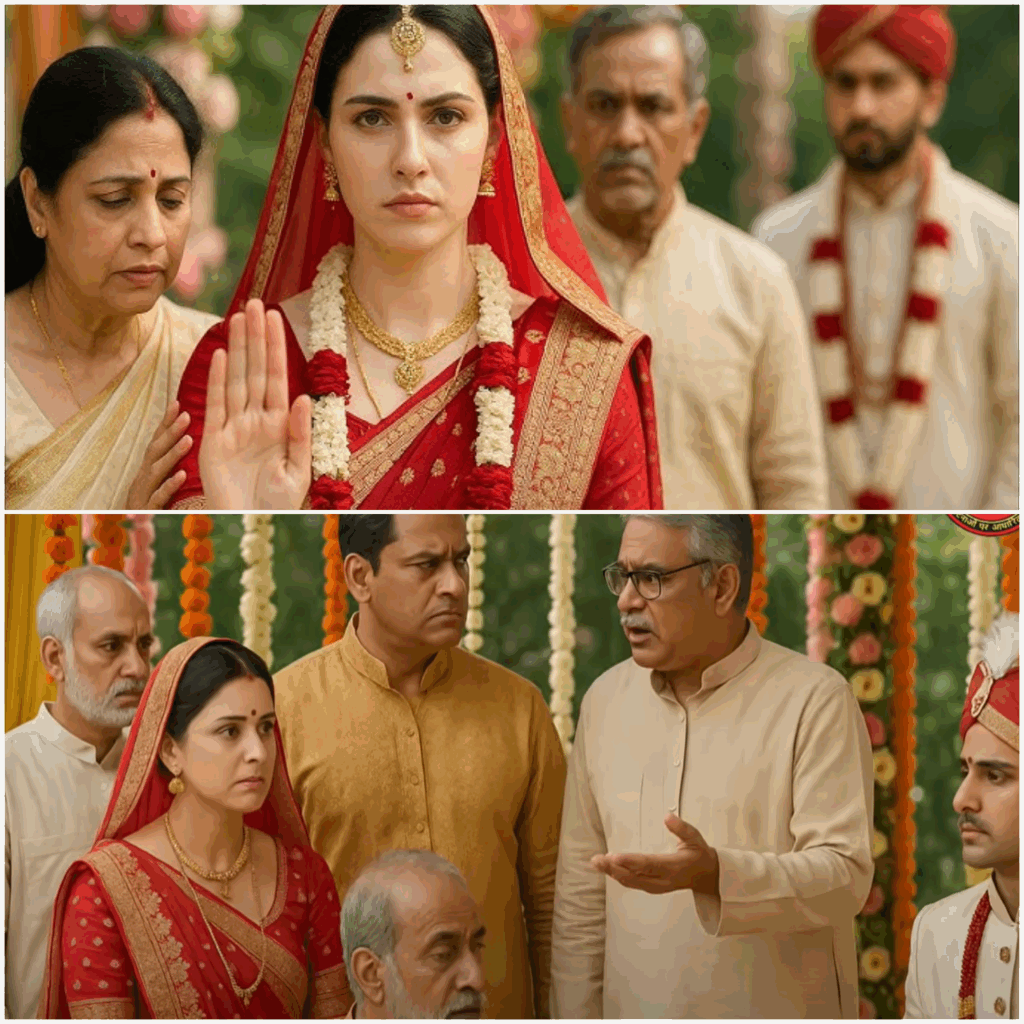
Rohan bowed his head in apology and stepped aside silently. The shehnai’s tune stopped abruptly. The floral tray for the varmala felt heavy as if weighed down by sorrow.
Aarti adjusted her veil, took her parents’ hands, and started walking down the steps. The crowd was silent except for the faint clicking of cameras. In her heart, Aarti thought, “Today, the marriage did not break. Today, my self-respect was saved.”
Just as they were about to leave the mandap, a clear voice called out from behind, “Wait a minute! If respect is the condition, then I am ready to marry this girl without any dowry.”
Everyone turned to see a young man in simple clothes, carrying an old bag on his shoulder. His eyes were filled with confidence. He introduced himself, “I am Aditya.”
Stepping forward, he said, “I do not want dowry. I want a partner who will walk beside me as an equal. If Aarti agrees, I can promise to honor this relationship clearly and honestly right here, right now.”
The atmosphere in the mandap changed. Some whispered, “Who is this man?” Others murmured, “He speaks plainly.”
Aarti looked at Aditya. His face was simple, his words sincere. She glanced at her parents. Their eyes reflected both worry and relief.
“I will not answer now,” Aarti said softly. “First, I want to understand who you are and what you believe in.”
Aditya nodded, “That’s fair. No pressure. Decisions must come from understanding.”
The evening breeze blew softly as the tent lights dimmed behind them. Aarti thought, “I will not bow to dowry, but I will not rush either.”
This was the beginning of a new chapter — a refusal of dowry and an honest proposal without noise or pretense.
The baraat quietly withdrew. People still looked on in surprise. As Aarti and her parents stepped outside, Aditya came forward again, folding his hands respectfully.
“I know you are hurt now,” he said. “But what I said was not a joke. If Aarti agrees, I am ready to marry without dowry.”
Whispers spread. “Who is this boy? Look at his clothes. He seems like a common man. Is he really serious or just showing off?”
Devendra looked straight at him and asked, “Son, who are you? What is your family? What do you do?”
Aditya calmly replied, “I work as a library assistant at a nearby college. My family is small. My parents are elderly. I don’t have much, but I do have one thing — I will never disrespect a girl because of dowry.”
Aarti’s mother looked at her daughter in surprise. “Beta, this is all happening so suddenly. We need time to think.”
Aarti also looked at Aditya directly. “You don’t even know me. Why do you want to marry me?”
Aditya smiled gently. “Today, I heard you speak in the mandap. I saw your courage — a girl standing up for her father’s dignity. What greater virtue can one ask for? If life passes with such a person, how can it be wrong?”
The crowd stirred again. Some said, “The girl is lucky. Who says no to dowry these days?” Others taunted, “He is poor. He will ruin the girl’s life.”
Devendra was silent. His face showed the inner conflict.
His wife whispered, “Aarti, the society’s opinions will come. We must decide carefully.”
Aarti looked at her mother and said calmly, “If I had stayed silent out of fear of society, my whole life would have been ruined. Today, I want to listen to my heart. If this relationship is based on respect and trust, then it is right.”
Devendra looked at his daughter. There was no fear in his eyes now. He said firmly, “If you have made up your mind, I am with you. This time, we will not bow to pressure.”
Aarti looked at Aditya. He smiled, but his eyes held truth. She thought, “Maybe this is the real relationship — where no one needs to convince or bend.”
The next morning, Aarti, her parents, and Aditya went to his home. It was a small neighborhood with narrow lanes and faded blue walls. The house had three rooms and an old charpai in the courtyard. Aditya’s mother stood outside in a white cotton saree, her face lined with wrinkles but her eyes shining with honesty.
She smiled warmly, “Please come in. We are very happy to have you here.”
Inside, the room was simple — an old wooden cupboard, a table piled with books, and a small picture of God on the wall.
Devendra looked around and sighed deeply. “Son, you don’t have much, but at least cleanliness and honesty are clear.”
Aditya laughed, “Uncle, I may not have wealth, but I have hard work. I want to live life with that.”
Aarti quietly observed everything, questions swirling in her mind. Could she live in this simple home? Could she endure the hardships?
Just then, Aditya’s mother placed her hand gently on Aarti’s and said, “Beta, we don’t have much, but we will treat you not as a daughter-in-law, but as our daughter. You will never feel alone.”
Tears welled up in Aarti’s eyes. Yesterday, she was being bought like property in the mandap; today, she was being embraced as family.
However, outside in the neighborhood, whispers began again. “Look, Aarti is going to a poor home now.” “Yesterday they demanded a car, and now she will ride a rickshaw.” “Will this marriage even last?”
Aarti’s mother heard these and worried. “Beta, we have to listen to society sometimes. We must decide carefully.”
Aarti looked at her mother and said firmly, “Mom, if I had stayed silent out of fear of society, my life would have been wasted. Today, I want to follow my heart. If this relationship is built on respect and trust, then it is right.”
Devendra nodded, “If you have decided, I support you. This time, we will not bow to pressure.”
The wedding day was set quietly — no band, no grand baraat. Only a few relatives, neighbors, and family gathered at the neighborhood temple.
Aarti sat on the temple steps wearing a simple red saree, a light sindoor on her forehead, and a small garland around her neck. Aditya wore a white kurta-pajama. Without any show, they stood together.
The priest began the mantras. Devendra and his wife sat beside Aarti, tears in their eyes — but these were tears of relief and pride, not sorrow.
Neighbors came to watch. Some mocked, “She rejected a big baraat and now is having a small temple wedding.” Others laughed, “She chose a rickshaw life instead of a car.”
But some quietly admired Aarti’s courage. An elderly uncle whispered, “Who has such courage nowadays? She is doing the right thing.”
The rituals completed. After the seven rounds, Aditya folded his hands before Aarti’s mother.
“From today, your daughter is also my responsibility. I will never leave her alone.”
Tears streamed down her face. She touched Aditya’s forehead like a son.
Devendra placed his hand on Aditya’s shoulder. “Son, we cannot give dowry, but we give you our blessings.”
Aarti smiled genuinely at Aditya for the first time. She felt this marriage was not about show but about respect and trust.
The temple bells rang, flowers showered. Society might say anything, but at that moment, Aarti knew she had chosen the right path.
Life after marriage was simple. Their home had two rooms — one for Aditya’s parents, one for the couple. The roof leaked in rains and scorched in summer, but to Aarti, this home was bigger and truer than any grand mandap.
Aditya left early every morning for work at the library. His salary was small but earned honestly. Aarti managed the house, cared for her in-laws, and began teaching neighborhood children.
The beginning was tough. Money was tight, sometimes they had to buy half milk or cheaper vegetables. The house walls got damp in the rains. Neighbors mocked, “She left a big wedding for this hut. What a fate she chose.”
Aarti listened but smiled quietly. She thought, “What use is a showy life? I want a true partner, and I have found one.”
In the evenings, when Aditya returned tired, they sat together on the porch talking. Aditya would say, “No matter what people say, one day I will prove with my hard work that we made the right choice.”
Aarti looked into his eyes and said, “I trust you more than your promises. That is the greatest dowry.”
Time passed. Aditya continued studying for competitive exams, burning the midnight oil. Aarti supported him with tea and encouragement.
Her in-laws began treating her like their own daughter. The house was small, but love was immense.
Slowly, the neighbors’ taunts lessened. Many women came to Aarti, saying, “Daughter, we want to teach our daughters to be brave like you.”
Aarti smiled, “Remember, there is no greater dowry than self-respect.”
One night, after everyone slept, Aditya closed his books and said, “Aarti, I think the time is coming when our hard work will pay off.”
Aarti looked at him and said, “Yes, and that day we will answer the whole society.”
Years went by. Aditya passed his exams and was selected as a government officer. His promotion brought pride to the family.
The neighbors who once mocked now came to the door, saying, “Forgive us, daughter. We were wrong. Your decision was right.”
Some said, “Aarti, you have truly set an example.” Others said, “May everyone get a son-in-law like Aditya.”
Devendra and his wife were proud beyond words. The same society that once mocked now praised their daughter.
A city newspaper featured the story: “Poor boy becomes officer; wife stands by him through hardships.”
Aarti held the newspaper and smiled, “Aditya, now people will understand that marriage is not about dowry, but about trust.”
Aditya held her hand and said, “If you had not shown courage that day, none of this would have happened.”
Tears of happiness glistened in their eyes. But those tears also carried a message — their life was no longer just theirs but a beacon of hope.
Aditya, now a senior officer, was respected in the neighborhood. Official cars came and went, but their home remained simple, where hard work, honesty, and love were the foundation.
Aarti continued teaching the children of the neighborhood, inspiring girls to stand for their dignity.
Girls would tell her, “Didi, we will also stand up for our respect like you.”
Aarti would smile and say, “Remember, there is no greater dowry than self-respect.”
Devendra, when he went to the market, was greeted with respect. “This is Aarti’s father,” people said, proud of the daughter who had stood tall in the mandap.
His wife often sat in the courtyard, thinking how different life would have been if Aarti had given in to fear that day.
One evening, Aditya came home in his office clothes. Aarti was waiting at the gate, smiling.
“Remember, Aditya?” she said. “People mocked me in the mandap. Today, the same people praise us.”
Aditya looked into her eyes, “Yes, Aarti, because you chose that day. And a relationship built on that will never fail.”
Aarti looked up at the stars shining in the sky, her heart echoing one truth:
Marriage is not about dowry. It is about trust and self-respect.
Now, a question for you: If your daughter, sister, or you yourself were in such a situation where dowry was demanded in the mandap, would you have the courage to stand like Aarti and break the marriage? Share your thoughts in the comments. Your words might inspire someone else.
If this story touched your heart, please like, subscribe, and share it with your friends and family. Write your name and city in the comments so we know how far our stories are reaching.
Until next time, stay happy, stay healthy, and cherish your family.
Jai Hind!
.
play video:
News

Doktorlar mafya babasının kısır olduğunu söyledi—bir garson ondan hamile olduğunu söyleyene kadar.
Doktorlar mafya babasının kısır olduğunu söyledi—bir garson ondan hamile olduğunu söyleyene kadar. . . . Chicago’nun karanlık ve acımasız yeraltı…

Tarihin En Acımasız Emri: 15.000 Esir Askeri Kör Edip Geri Gönderdi
Tarihin En Acımasız Emri: 15.000 Esir Askeri Kör Edip Geri Gönderdi . . . Karanlığın Yürüyüşü: Bir İmparatorun Soğuk Zaferi…
Köle Kadından Doğan Beyaz Çocuklar, Koca Bir Plantasyonu Nasıl Çökertti?
Köle Kadından Doğan Beyaz Çocuklar, Koca Bir Plantasyonu Nasıl Çökertti? . Köle Kadından Doğan Beyaz Çocuklar: Blackwood’un Çöküşü Güneyin yaz…
Bilim İnsanlarını Şaşkına Çeviren Çocuk: Elias’ın Vakası
Bilim İnsanlarını Şaşkına Çeviren Çocuk: Elias’ın Vakası . . . Bilim İnsanlarını Şaşkına Çeviren Çocuk: Elias’ın Vakası 1972 yılının dondurucu…
1997’de Sarıçöl’de Kaybolan Selim Karabey – 16 Yıl Sonra Bulunan Mataranın Sakladığı Gizemler
1997’de Sarıçöl’de Kaybolan Selim Karabey – 16 Yıl Sonra Bulunan Mataranın Sakladığı Gizemler . . . 1997’DE SARIÇÖL’DE KAYBOLAN SELİM…
Sıradan Bir Tokat, 20 Yıllık Sırrı Ortaya Çıkardı: O Adam Geri Döndü!
Sıradan Bir Tokat, 20 Yıllık Sırrı Ortaya Çıkardı: O Adam Geri Döndü! . . . Sıradan Bir Tokat, 20 Yıllık…
End of content
No more pages to load