
Faith, Rumors, And The Court Of Social Media: The Marriage Of Shipra Sharma And Indresh Upadhyay
Faith, Rumors, and the Court of Social Media: The Marriage of Shipra Sharma and Indresh Upadhyay
In today’s digital age, the line between truth and rumor has become dangerously thin. Social media platforms have transformed into powerful arenas where individuals can be elevated to the heights of reverence one moment and placed under ruthless public scrutiny the next. Judgments are delivered instantly—often without complete information, verification, or sensitivity. The recent controversy surrounding the marriage of renowned Vrindavan-based storyteller and devotional singer Indresh Upadhyay and his wife, Shipra Sharma, stands as a striking example of this phenomenon.
What was meant to be a private celebration of companionship soon turned into a public spectacle, exposing deeper questions about privacy, morality, faith, and the collective behavior of online communities.
A Wedding That Sparked a Debate
On December 6, 2025, Indresh Upadhyay entered into marriage with Shipra Sharma at the Taj Amer Hotel in Jaipur. The ceremony was conducted with simplicity, attended by close family members and a limited circle of acquaintances. When photographs and videos from the wedding surfaced online, social media was initially flooded with congratulatory messages and expressions of goodwill.
For years, Indresh Upadhyay had preached devotion, discipline, and balance through his spiritual discourses and bhajans. Many followers viewed his decision to marry as a natural and legitimate step in life. Supporters emphasized that spiritual pursuit and household life are not mutually exclusive, citing long-standing traditions within Indian philosophy that recognize both paths as valid.
Several devotees praised the couple, calling their union ideal and divinely blessed. For a brief period, the atmosphere surrounding the marriage remained overwhelmingly positive.
The Reddit Post That Changed the Narrative
However, social media sentiment is rarely stable. Within a day of the wedding, a post appeared on Reddit claiming that Shipra Sharma had been previously married. The post included old photographs and video clips, presented as supposed evidence. Initially overlooked by many, the post rapidly gained traction and spread across multiple platforms.
Questions began pouring in. Was this Shipra Sharma’s first marriage? Had details been deliberately concealed? Speculation escalated quickly, shifting focus from the marriage itself to allegations about her past. As often happens in such cases, curiosity soon gave way to judgment, and judgment turned into character assassination.
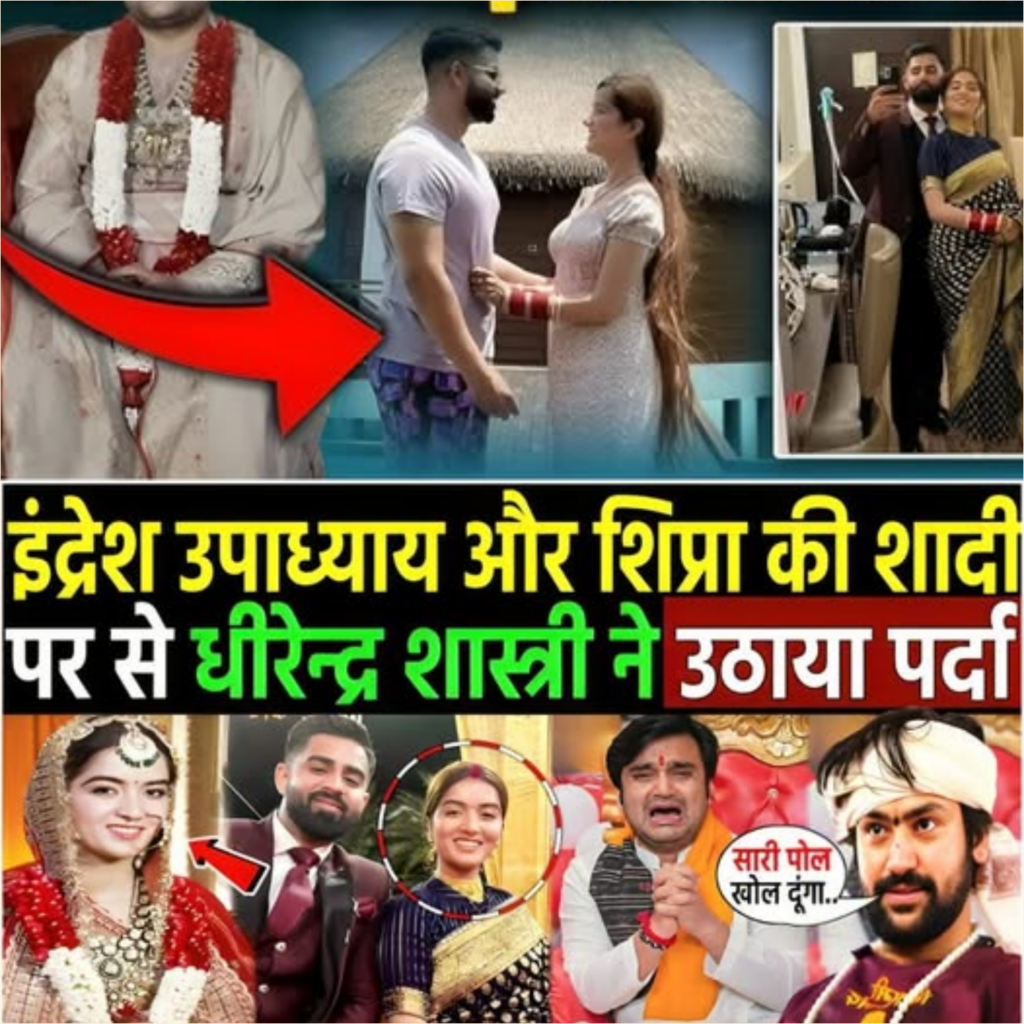
Private Life Under Public Trial
The controversy raised a critical question: does social media have the authority to put someone’s private life on trial without verified facts? Is it acceptable to scrutinize a woman’s past based on unconfirmed claims and selectively presented content?
Several observers pointed out that in an era of artificial intelligence and advanced editing tools, images and videos can easily be manipulated or taken out of context. Despite this, rumors were circulated and consumed as established truth, highlighting the speed at which misinformation can overpower reason.
From Shipra Bhava to Shipra Sharma
Another dimension of the controversy centered on Shipra Sharma’s identity. Prior to her marriage, she was known on social media as Shipra Bhava and ran a YouTube channel titled “Pankh Govind,” where she shared devotional songs, spiritual reflections, and personal vlogs. Shortly before the wedding, older videos from her channel were removed, leading to further suspicion.
While it is not uncommon for individuals to clean up their digital footprint before marriage, especially when entering a new phase of life, this decision was interpreted negatively due to the heightened scrutiny surrounding her association with a public religious figure.
Her surname also became a topic of debate, with some users linking it to caste and lineage. Such discussions overlooked a fundamental truth: the names and identities chosen by consenting adults are personal matters, not public property.
Questions Over the Wedding Venue
Another point of contention was the location of the wedding. Some followers questioned why the ceremony took place in Jaipur instead of Vrindavan. While every individual has the right to choose where they marry, the prevailing atmosphere of suspicion turned even this personal decision into a subject of debate.
Silence and Its Interpretations
Throughout the controversy, neither Indresh Upadhyay nor his family issued a detailed public statement. Supporters viewed this silence as a wise decision, arguing that any response in a hostile environment could be misinterpreted or manipulated. Critics, however, saw the lack of clarification as fuel for further doubt.
During this time, an old video of Indresh Upadhyay’s father, Krishna Chandra Thakur, resurfaced online. In the clip, he spoke positively about his future daughter-in-law’s values and upbringing. Removed from its original context, the video was used by some to intensify the controversy rather than resolve it.
The Burden Placed on Women
Perhaps the most troubling aspect of the entire episode was the disproportionate pressure placed on Shipra Sharma. Her past, appearance, clothing, and online presence were dissected relentlessly. This pattern reflects a persistent societal bias in which women are subjected to harsher judgment during public controversies.
Very few voices considered the emotional and psychological toll such public shaming can inflict. The language used in many online discussions crossed the boundaries of decency, raising concerns about digital ethics and empathy.
Legal and Ethical Perspectives
Legal experts and social commentators were quick to clarify that a second marriage is neither illegal nor immoral under Indian law. Yet, in the economy of social media, legality and nuance often lose out to outrage and sensationalism.
The episode demonstrated how online platforms can transform into informal courts, where verdicts are issued without evidence, defense, or due process.
Lessons From the Controversy
As days passed, the controversy gradually faded, replaced by new topics and trends. However, the questions it raised remain relevant. Did society rush to judgment without sufficient information? Did rumors overpower facts?
The incident offers a crucial lesson: if we cannot extend kindness, we should at least refrain from spreading harm. Asking questions is not wrong, but making accusations without proof is.
Conclusion
The marriage of Indresh Upadhyay and Shipra Sharma was a private milestone that became an unintended public spectacle. More than a story about two individuals, it exposed the darker tendencies of social media culture and herd mentality.
Perhaps it is time to pause, reflect, and exercise restraint. Not every viral post deserves belief, and not every personal life deserves public dissection. Truth has a way of emerging on its own—but until then, dignity and respect should not be sacrificed at the altar of speculation.
News

प्रेग्नेंट महिला को बस में खड़े देख अपनी सीट दे दी थी ,कुछ साल बाद जो मिला वो कभी सोचा भी नहीं था
प्रेग्नेंट महिला को बस में खड़े देख अपनी सीट दे दी थी ,कुछ साल बाद जो मिला वो कभी सोचा…

Emekli Paşaların Gölgesindeki Yolsuzluk Korgeneral Ayla Sancak’ın İhanet Temizliği
Emekli Paşaların Gölgesindeki Yolsuzluk Korgeneral Ayla Sancak’ın İhanet Temizliği . . . Emekli Paşaların Gölgesindeki Yolsuzluk: Korgeneral Ayla Sancak’ın İhanet…

Türkler Sahada İş Bilmez” — 8 Dakika 30 Saniyede Cevap Verdiler
Türkler Sahada İş Bilmez” — 8 Dakika 30 Saniyede Cevap Verdiler . . . Başlangıç: Bir Tatbikat ve Bir Meydan…

Türk Hademe – “Köpeğim Ol” Diyen Yüzbaşıyı – Tek Hamlede Diz Çöktürdü
Türk Hademe – “Köpeğim Ol” Diyen Yüzbaşıyı – Tek Hamlede Diz Çöktürdü . . . Türk Hademe – “Köpeğim Ol”…

कनाडा में भारतीय लड़कियों का चौंकाने वाला कांड! जो सामने आया, उसने सबको सन्न कर दिया!
कनाडा में भारतीय लड़कियों का चौंकाने वाला कांड! जो सामने आया, उसने सबको सन्न कर दिया! . . . कनाडा…
इंस्पेक्टर मैडम चोर को पकड़ने पहुँची, सामने निकला तलाकशुदा पति | सच्ची कहानी | Emotional Story
इंस्पेक्टर मैडम चोर को पकड़ने पहुँची, सामने निकला तलाकशुदा पति | सच्ची कहानी | Emotional Story . . . इंस्पेक्टर…
End of content
No more pages to load