Iran to Attack 12000 American Troops in Middle East | Tehran Warns US, Trump & Netanyahu | N18G
.
.
.
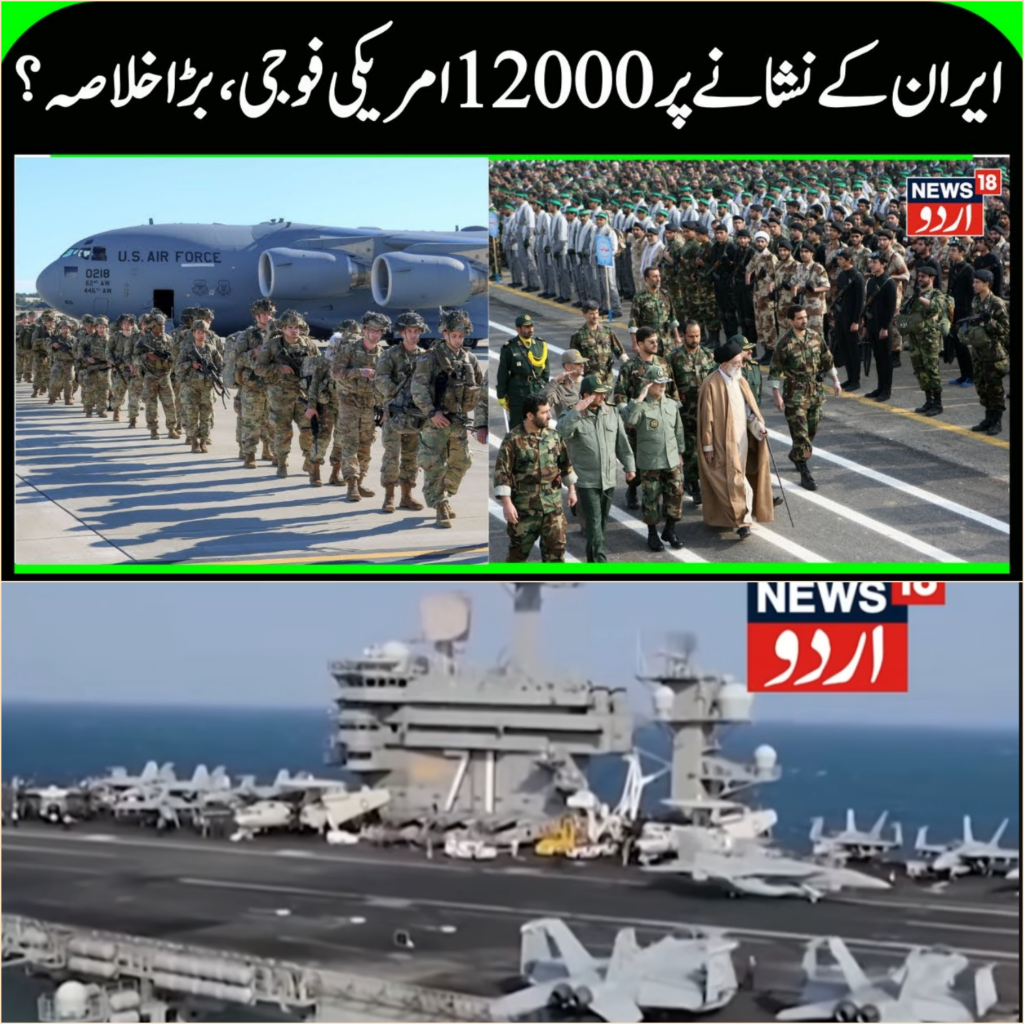
Iran Warns of Retaliation Against 12,000 U.S. Troops in the Middle East as Regional Tensions Escalate
Middle East Desk | International Affairs
Tensions in the Middle East have escalated sharply after Iran issued one of its strongest warnings yet to the United States and Israel, threatening retaliation against American military personnel stationed across the region. Iranian officials and state-linked media have claimed that nearly 12,000 U.S. troops deployed in the Middle East would be primary targets if Washington or Tel Aviv initiates military action against Tehran.
The warning comes amid heightened regional volatility involving Iran, Israel, and the United States, with fears growing that a single miscalculation could push the region toward a broader conflict.
Iran’s Stark Warning
In a series of statements reported by Iranian media, officials declared that American forces deployed across the Middle East—particularly in the Gulf region—are already “within Iran’s firing range.” The rhetoric marks a significant shift from previous warnings, as Tehran openly named U.S. troop concentrations as potential targets rather than issuing generalized threats.
According to these statements, Iran has identified American military bases, airfields, and naval assets across the Middle East as part of a newly defined strategic roadmap. Iranian officials asserted that if Iran is attacked—directly or indirectly—by the United States or Israel, retaliation would not be symbolic but immediate and region-wide.
Iranian commentators went as far as stating that the Persian Gulf and surrounding areas would become “graveyards” for American forces, language that underscores the seriousness of the warning.
Who Are the 12,000 U.S. Troops?
While the figure of 12,000 U.S. troops has not been independently verified, American forces are known to be stationed across multiple Middle Eastern countries, including Iraq, Syria, Kuwait, Bahrain, Qatar, and the United Arab Emirates.
These troops operate from air bases, intelligence hubs, naval facilities, and logistics centers. Their stated mission includes counterterrorism operations, regional surveillance, and the protection of U.S. interests and allies.
Iranian officials claim that these deployments make American forces “geographically vulnerable,” especially in the event of missile or drone strikes.
Shift in Iran’s Military Doctrine
Iranian statements suggest a notable shift in strategic posture. Instead of focusing exclusively on deterrence or defensive responses, Tehran has openly described a pre-planned response framework that prioritizes U.S. assets in the region.
Iranian military analysts claim the country has completed operational preparations involving:
Hypersonic missile capabilities
Precision-guided ballistic missiles
Drone swarms
Naval strike strategies in the Persian Gulf
Iran insists that while it lacks the ability to strike targets like Washington or New York directly, it does not need to do so. From Tehran’s perspective, American military presence in the Middle East represents a closer and more immediate target.
Role of Israel and Regional Flashpoints
Iran has repeatedly accused Israel of provoking conflict through covert operations, airstrikes, and intelligence actions. Tehran has warned that any Israeli military escalation—especially with U.S. backing—would trigger retaliation not only against Israel but also against American forces across the region.
The warning comes amid ongoing hostilities involving Israeli military operations and heightened alerts across the region.
Iranian officials have also stated that any missile launched toward Iranian territory—whether from Israeli or U.S. platforms—would be treated as an act of war.
Persian Gulf and U.S. Naval Assets
One of the most significant elements of Iran’s warning concerns U.S. naval deployments in the Persian Gulf. Iranian media explicitly referenced the U.S. aircraft carrier strike groups, often described as symbols of American power.
According to Iranian military commentators, these naval assets are no longer viewed as untouchable. Instead, Iran claims to have developed strategies capable of targeting such vessels using a combination of missiles, drones, and asymmetric naval tactics.
While U.S. officials have not confirmed any specific threats to individual carriers, the rhetoric has intensified concerns about maritime security in one of the world’s most critical shipping corridors.
Domestic Mobilization Inside Iran
Reports from Iranian media also indicate increasing domestic mobilization. Footage aired on Iranian platforms shows civilians participating in military drills, with some reportedly wearing symbolic burial shrouds as a sign of readiness for conflict.
Iranian leaders have framed this mobilization as a message of national unity and deterrence, asserting that Iran is prepared for a prolonged confrontation if necessary.
Despite rumors circulating on social media that Iran’s Supreme Leader Ali Khamenei had moved to a secure bunker, Iranian officials publicly denied such claims. Khamenei later appeared at a public gathering, delivering a speech in which he emphasized resistance and readiness rather than concealment.
U.S. and Israeli Silence
At the time of writing, there has been no direct confirmation or detailed response from the U.S. Department of Defense regarding Iran’s specific claims. However, American officials have consistently stated that U.S. forces remain prepared to defend themselves and their allies.
Similarly, Israeli leadership has not officially commented on the Iranian warnings, though Israel has repeatedly stated that it reserves the right to act against threats to its national security.
The escalating rhetoric places leaders such as Donald Trump and Benjamin Netanyahu at the center of global attention, as any policy decisions could have far-reaching consequences.
Impact on the Region
The warnings have already begun to affect daily life in parts of the Middle East. Security levels have reportedly increased near U.S. facilities, while regional governments are monitoring developments closely.
Analysts warn that heightened tensions could disrupt:
Commercial shipping in the Persian Gulf
Energy markets and oil prices
Diplomatic efforts involving nuclear negotiations
Regional stability across Iraq, Syria, and the Gulf states
The possibility of miscalculation—particularly involving missile launches, drone incidents, or naval encounters—remains a significant concern.
Experts Urge Restraint
International security experts caution that while rhetoric is often used as a tool of deterrence, the language employed by Iranian officials is unusually explicit.
“This is not just signaling,” said one Middle East analyst. “It’s a declaration of intended response pathways. The danger lies in how quickly escalation could spiral beyond control.”
Others argue that Iran’s statements are aimed at discouraging military action rather than initiating conflict. According to this view, Tehran is attempting to raise the perceived cost of intervention high enough to force diplomatic restraint.
What Happens Next?
The coming weeks are expected to be critical. Diplomatic backchannels may intensify as global powers attempt to de-escalate tensions. However, military readiness on all sides suggests that preparations for worst-case scenarios are already underway.
Iran has made its position clear: any attack on its territory or leadership will be met with immediate and widespread retaliation targeting U.S. forces across the Middle East.
Whether these warnings remain rhetorical—or evolve into action—will depend on decisions made in Washington, Tel Aviv, and Tehran.
Conclusion
Iran’s warning regarding the potential targeting of 12,000 American troops represents one of the most serious escalations in regional rhetoric in recent years. While the statements remain unverified claims rather than confirmed operational plans, they underscore the fragile security environment in the Middle East.
As tensions rise, the world watches closely, aware that even a single misstep could transform warnings into reality.
For now, diplomacy remains the only path capable of preventing a wider conflict—one whose consequences would extend far beyond the Middle East.
News
Sınırda devriye geziyordu ve 2005’te kayboldu — 18 yıl sonra kamyoneti bulundu…
Sınırda devriye geziyordu ve 2005’te kayboldu — 18 yıl sonra kamyoneti bulundu… . . . Sınırda Devriye Geziyordu ve 2005’te…

Polis Acilin Önünde Hemşirenin Boğazını Sıktı—Hastane Müdürünün Eşi Olduğunu Bilmiyordu,Sonrası Şok!
Polis Acilin Önünde Hemşirenin Boğazını Sıktı—Hastane Müdürünün Eşi Olduğunu Bilmiyordu,Sonrası Şok! . . . Polis Acilin Önünde Hemşirenin Boğazını Sıktı—Hastane…
Türkler Helikopter Pilotluğundan Ne Anlar? Türk ATAK Pilotu 11 Hedef Düşürdü! 🇹🇷 Red Flag Şoku
Türkler Helikopter Pilotluğundan Ne Anlar? Türk ATAK Pilotu 11 Hedef Düşürdü! 🇹🇷 Red Flag Şoku . . . Türkler Helikopter…

Amerikalı Profesör REZİL oldu! “Soykırım” dedi ama… Türk Tarihçi Harvard’da Belge Gösterdi! 🇹🇷
Amerikalı Profesör REZİL oldu! “Soykırım” dedi ama… Türk Tarihçi Harvard’da Belge Gösterdi! 🇹🇷 . . . Amerikalı Profesör Rezil Oldu!…

İkizler 1985’te kayboldu, 25 yıl sonra tarlada şok edici sır bulundu!
İkizler 1985’te kayboldu, 25 yıl sonra tarlada şok edici sır bulundu! . . . Bu sabah, tıpkı her sabah olduğu…

Küçük Oğlan 1988’de Kreşten Kayboldu — 20 Yıl Sonra Anne Oyuncak Kutusunda Korkunç Sırrı Buldu!
Küçük Oğlan 1988’de Kreşten Kayboldu — 20 Yıl Sonra Anne Oyuncak Kutusunda Korkunç Sırrı Buldu! . . . Küçük Oğlan…
End of content
No more pages to load