When Private Lives Become Public Trials: The Social Media Controversy Surrounding Shipra Bawa and Indresh UpadhyayIndia | Social Affairs & Media Analysis
In the age of social media, the boundary between private life and public judgment has become increasingly fragile. For individuals associated with religion, spirituality, or public influence, this boundary often disappears altogether. Every personal decision is scrutinized, debated, and moralized by millions of strangers online.
This reality came sharply into focus following the recent controversy surrounding Shipra Bawa (also known as Shipra Sharma) and Indresh Upadhyay, whose marriage became the subject of intense online debate, speculation, and moral policing. What began as wedding photographs shared on social media soon escalated into allegations, rumors, and character judgments—particularly targeting the woman at the center of the story.
This article examines the controversy not to validate rumors, but to understand how social media narratives are constructed, why women disproportionately bear the burden of moral judgment, and what this episode reveals about privacy, religion, and public expectations in contemporary India.
The Marriage That Sparked a Storm
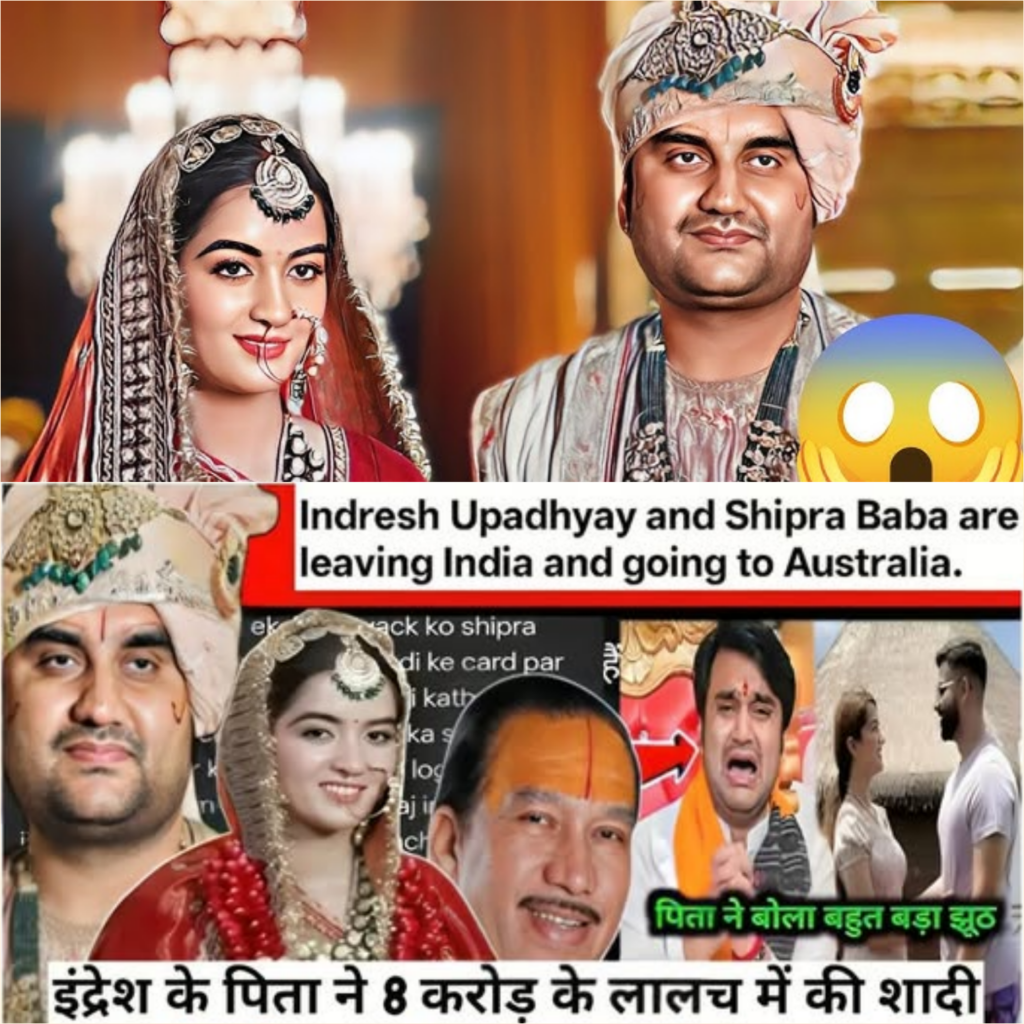
On December 6, 2025, Indresh Upadhyay and Shipra Sharma were married in a private ceremony at the Taj Amer Hotel in Jaipur. The wedding was attended by family members and close associates and was, by all available accounts, a personal event.
Soon after, photographs and short videos from the ceremony surfaced online. Initially, reactions were overwhelmingly positive. Admirers praised the couple, with some going as far as drawing symbolic comparisons to Radha and Krishna—an indication of how deeply religious imagery influences public perception of spiritual figures.
However, within days, the tone of online discourse changed dramatically.
From Celebration to Suspicion
The shift began when anonymous posts appeared on platforms such as Reddit and X (formerly Twitter), alleging that Shipra Sharma had been previously married. Old photographs and videos—unverified and lacking clear context—were circulated widely. Speculation followed rapidly, often without restraint or verification.
Soon, claims escalated:
That Shipra had been married before
That she had changed her surname
That her previous digital presence had been erased deliberately
That aspects of her past were concealed before marriage
None of these claims were supported by official statements or verified documentation. Yet, in the court of social media, speculation quickly hardened into assumed truth.
The Pregnancy and Australia Rumors
Amid this online turbulence, another narrative emerged—one that intensified public outrage. Some social media users alleged that Shipra was pregnant and was planning to leave India for Australia to “hide” her pregnancy from public scrutiny.
Once again, no verified source confirmed these claims. No medical statement, legal filing, or official announcement substantiated them. Yet, the rumor gained traction, fueled by emotional language, emojis expressing anger, and selectively edited video clips.
This pattern is not new. In many viral controversies, speculation is rewarded with engagement, while restraint and verification are sidelined.
A Gendered Narrative
Notably, the focus of scrutiny remained overwhelmingly on Shipra.
Her past relationships—real or imagined—were dissected. Her surname change was interpreted as deception, despite the fact that surname changes are common in many Indian marriages and social contexts. Her digital choices, including the removal of older videos from YouTube, were portrayed as evidence of wrongdoing rather than a personal decision.
Rarely did the conversation extend equally to her husband.
This imbalance reflects a broader social pattern: women’s lives are subjected to harsher moral judgment, especially when they are associated with religious or spiritual environments.
The Question of Privacy in Public Life
A key argument raised by critics was that individuals associated with spirituality, religion, or moral leadership cannot claim full privacy. According to this view, their personal choices must align with idealized social norms because followers may model their behavior accordingly.
This argument has deep roots in traditional Indian thought, where gurus, saints, and leaders were expected to embody near-perfect moral standards.
However, modern society presents a more complex reality.
Indresh Upadhyay is a public figure, but he is also an individual with the legal and ethical right to marry, choose a partner, and define the boundaries of his private life. Shipra Sharma, despite being thrust into public attention, did not voluntarily assume a public leadership role.
The question then becomes: Where does accountability end and intrusion begin?
Old Photos, New Judgments
One of the most contentious aspects of the controversy involved the circulation of old photographs and videos allegedly showing Shipra participating in wedding rituals or celebrations.
Supporters argued that:
Images can be misinterpreted
Videos lack verified timelines
Digital manipulation and AI-generated content are increasingly common
Critics, however, treated these visuals as conclusive proof of past marriages, without considering alternative explanations such as family functions, cultural ceremonies, or unrelated events.
In the absence of verified evidence, such interpretations remain speculative.
Silence as Strategy—or Fuel?
Neither Indresh Upadhyay nor Shipra Sharma issued a detailed public statement addressing the allegations. Their silence was interpreted in two opposing ways.
Supporters viewed it as a wise refusal to dignify rumors with responses, arguing that engaging with online speculation often prolongs controversy.
Critics, on the other hand, saw the silence as confirmation of guilt—demonstrating how social media often punishes restraint more than misinformation.
In reality, silence is neither admission nor denial. It is a choice—one that should not automatically be criminalized or moralized.
Religion, Expectations, and Human Fallibility
The controversy also reopened an old debate: should religious or spiritual figures be held to stricter personal standards than others?
Many argue yes. They believe spiritual leaders influence society and therefore must embody ideals in both public and private life.
Others counter that such expectations are unrealistic and dehumanizing. They argue that spirituality does not require erasing one’s past, denying personal relationships, or living under constant surveillance.
Importantly, even if Shipra Sharma had a previous marriage or relationship, that fact alone does not constitute moral failure. Divorce, remarriage, and personal reinvention are legal and increasingly common realities.
Social Media as Judge, Jury, and Executioner
This case illustrates how social media platforms amplify outrage faster than facts. Algorithms reward emotional reactions, not accuracy. As a result, rumors spread faster than corrections, and character judgments are passed without accountability.
For women especially, the cost is high:
Psychological distress
Reputational harm
Loss of dignity
Long-term digital footprints of unverified allegations
Once a narrative takes hold online, reversing it becomes nearly impossible—even if proven false later.
The Role of Society
Beyond the individuals involved, this controversy forces society to reflect on its own behavior.
Who grants the public the right to interrogate someone’s marriage, fertility, or past relationships?
Why are women expected to justify their life choices more than men?
And why do rumors command more attention than verified truth?
As many spiritual teachings emphasize, compassion, restraint, and humility are foundational values. Yet, these values often disappear in digital discourse.
Conclusion: Beyond the Headlines
At present, no verified evidence confirms many of the claims circulating online regarding Shipra Sharma’s past, pregnancy, or motives for travel abroad. Until official statements or credible documentation emerge, these narratives remain speculative.
What is undeniable, however, is the damage caused by unchecked rumor-mongering.
News

Doktorlar mafya babasının kısır olduğunu söyledi—bir garson ondan hamile olduğunu söyleyene kadar.
Doktorlar mafya babasının kısır olduğunu söyledi—bir garson ondan hamile olduğunu söyleyene kadar. . . . Chicago’nun karanlık ve acımasız yeraltı…

Tarihin En Acımasız Emri: 15.000 Esir Askeri Kör Edip Geri Gönderdi
Tarihin En Acımasız Emri: 15.000 Esir Askeri Kör Edip Geri Gönderdi . . . Karanlığın Yürüyüşü: Bir İmparatorun Soğuk Zaferi…

Köle Kadından Doğan Beyaz Çocuklar, Koca Bir Plantasyonu Nasıl Çökertti?
Köle Kadından Doğan Beyaz Çocuklar, Koca Bir Plantasyonu Nasıl Çökertti? . Köle Kadından Doğan Beyaz Çocuklar: Blackwood’un Çöküşü Güneyin yaz…

Bilim İnsanlarını Şaşkına Çeviren Çocuk: Elias’ın Vakası
Bilim İnsanlarını Şaşkına Çeviren Çocuk: Elias’ın Vakası . . . Bilim İnsanlarını Şaşkına Çeviren Çocuk: Elias’ın Vakası 1972 yılının dondurucu…

1997’de Sarıçöl’de Kaybolan Selim Karabey – 16 Yıl Sonra Bulunan Mataranın Sakladığı Gizemler
1997’de Sarıçöl’de Kaybolan Selim Karabey – 16 Yıl Sonra Bulunan Mataranın Sakladığı Gizemler . . . 1997’DE SARIÇÖL’DE KAYBOLAN SELİM…

Sıradan Bir Tokat, 20 Yıllık Sırrı Ortaya Çıkardı: O Adam Geri Döndü!
Sıradan Bir Tokat, 20 Yıllık Sırrı Ortaya Çıkardı: O Adam Geri Döndü! . . . Sıradan Bir Tokat, 20 Yıllık…
End of content
No more pages to load