This Is India
Emily Roberts and Sarah Williams grew up together in California. Their friendship began in childhood and followed them through college and into adulthood. Emily became a travel blogger, always chasing new places and stories. Sarah chose a different path—she became a documentary filmmaker, driven by a desire to understand real lives beyond polished headlines.
Between them, they had traveled to dozens of countries. But there was one place that always felt distant, mysterious, and controversial.
India.
What they knew about India came mostly from social media clips, half-baked news reports, and negative stereotypes—heat, crowds, poverty, noise, danger. Those words lingered in their minds. Yet beneath the assumptions was curiosity.
One evening, Emily finally said it out loud.
“If we truly want to understand the world,” she said, “we can’t keep ignoring India.”
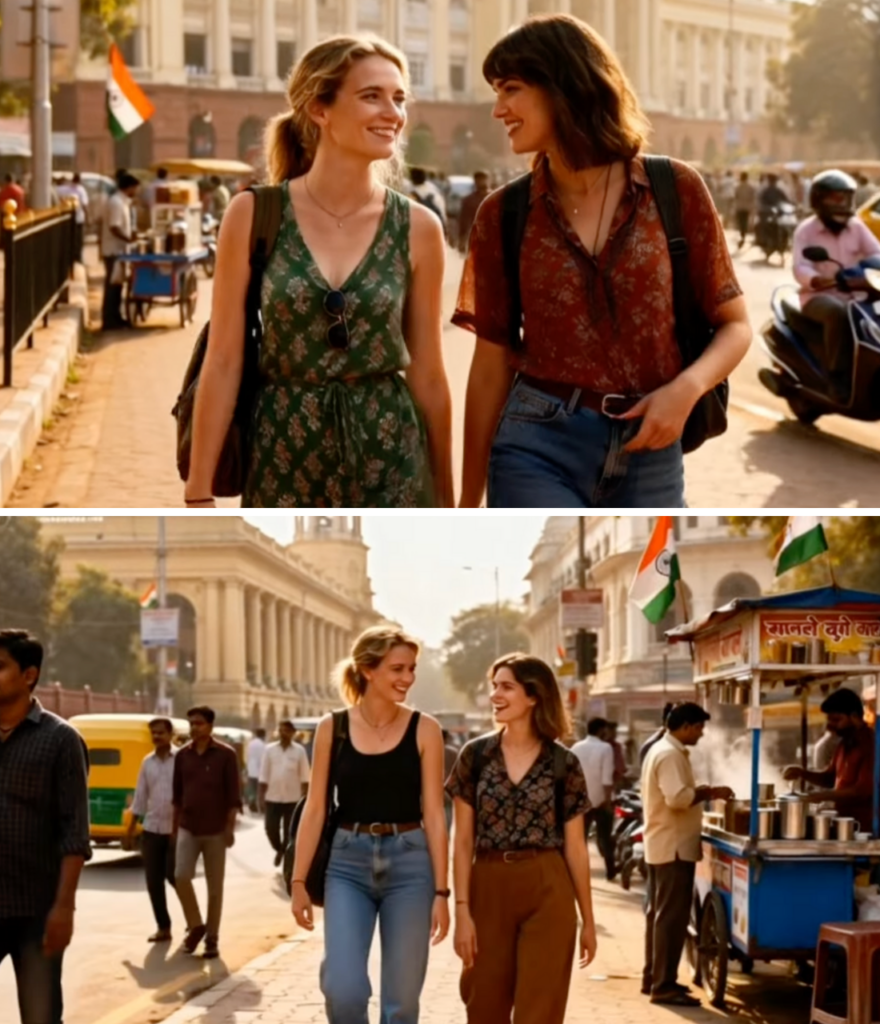
Sarah smiled, thoughtful. “Fine. But if we go, we don’t do the postcard version. I want the real life. Not the movie set.”
The decision was made.
They wouldn’t just visit big cities. They wanted to see the India that rarely made it into Western conversations.
First Impressions
Their journey began in Delhi.
As their plane landed at Indira Gandhi International Airport, both women braced themselves for chaos. Instead, they were met with something unexpected—modern buildings, clean roads, fast yet orderly traffic.
Emily whispered, almost surprised, “This… isn’t what I imagined.”
Sarah had already turned her camera on. “That’s the point,” she said. “We came with assumptions.”
Outside the airport, India revealed its first layer—people in colorful clothes, warm smiles, the smell of tea blending with spices in the air. It was overwhelming, but not in the way they had feared.
The real shock came the next day.
Old Delhi, New Understanding
In Old Delhi, the city felt alive. Narrow lanes, the towering walls of the Red Fort, the domes of Jama Masjid, and a constant pulse of movement. Emily stopped every few steps to take photos.
“This city breathes,” she said.
“And every stone has something to say,” Sarah replied.
That’s when they noticed a group of women walking through the market.
Rajasthani women—bright ghagras, heavy silver jewelry, colorful veils draped over their heads. They moved with confidence, laughing, bargaining, completely at ease in the crowd.
Sarah fell silent.
“Emily,” she said softly, “are you seeing this?”
“Yes,” Emily replied. “And I don’t understand why we were never shown this.”
One of the women, Kamla Devi, noticed their curious glances. She smiled and asked in broken English, “First time India?”
Sarah nodded. “Yes. And you look beautiful.”
Kamla Devi laughed. “This is our everyday dress. We are from Rajasthan.”
That simple exchange became the beginning of something deeper.
Stories Over Tea
Kamla Devi invited them to sit at a nearby tea stall. Hot chai arrived in clay cups, infused with ginger and cardamom. Sarah turned off her camera.
“Today,” she said, “I don’t want to film. I just want to understand.”
Kamla Devi told them about her life—how she had come to Delhi from a small village in Rajasthan with her children. Her husband worked in farming. Life wasn’t easy, but there was dignity.
“Our clothes are not just clothes,” she said. “They are our identity. Every color, every stitch tells a story.”
Emily remembered how often she had heard people back home say that Indian women were oppressed, voiceless, afraid.
She asked quietly, “Aren’t you scared—walking alone in such a crowded place?”
Kamla Devi answered without hesitation. “Fear exists in every country, daughter. But we don’t learn to live according to fear.”
That sentence stayed with Emily.
Nearby, foreign tourists clicked photos of the Rajasthani women—without asking, without understanding. Sarah felt uneasy.
“People see beauty,” she said, “but not the story.”
Kamla Devi smiled. “If you truly want to see India, come to Rajasthan.”
Emily and Sarah exchanged a glance.
The decision was already made.
Rajasthan: Beyond the Image
Two days later, they arrived in Jaipur.
Pink buildings, wide roads, forts rising in the distance—it felt unreal. As their taxi moved toward Amer Fort, they passed camels, folk musicians, and men in colorful turbans.
Inside the fort, surrounded by massive stone walls and grand courtyards, both women stood silent.
“We thought these forts were only about kings,” Emily said. “But this feels like the memory of an entire society.”
There, they met Radha Kanwar—a local guide in traditional attire, holding a tablet, speaking fluent English.
“This fort doesn’t just tell stories of war,” Radha explained. “It tells stories of women—queens and commoners—who shaped history in different ways. With swords, with wisdom, with sacrifice.”
Sarah’s eyes filled with tears.
“We thought we came here to observe,” she said. “But we’re here to learn.”
As the sun set, golden light washed over the city. Emily wrote in her notebook:
India is not what we were shown. It is far more. And this is only the beginning.
Life in the Village
Their journey continued beyond Jaipur—to a small village called Kharoda.
The city faded behind them, replaced by open desert, long roads, scattered trees, and distant homes. No tall buildings. Just mud houses, open courtyards, women sitting at doorways, children laughing freely.
Kamla Devi’s sister, Dhapu Bai, welcomed them into her home—mud walls, red chilies drying on the roof, a cow resting in the courtyard.
“This house is small,” Emily whispered, “but it feels peaceful.”
Dhapu Bai laughed. “Peace doesn’t come from things. It comes from people.”
Sarah observed village women working from morning to evening—fetching water, cooking, caring for children, helping in fields. Yet their faces carried warmth more than exhaustion.
“Do you ever feel your life is limited?” Sarah asked.
Dhapu Bai thought for a moment. “Everyone has limits. Yours are different from ours. The difference is—we don’t think our lives are small.”
That night, women sang folk songs. The soft beat of the dholak carried stories of generations. For the first time, Emily understood that freedom didn’t always look like the Western idea of it.
Sometimes, freedom meant living life on your own terms.
Changing Perspectives
The next day, Sarah picked up her camera again—but her lens had changed.
She interviewed Seema, the first girl from the village to attend college. Seema didn’t wear jeans. She didn’t speak fluent English. But her words were clear.
“I want to be like my mother,” she said. “And I want my daughter to go further than me.”
Emily closed her notebook.
“We thought we came to teach,” she told Sarah. “But we’re the ones changing.”
That evening, they sat on a hill watching the sun sink behind the village lights.
“When this documentary releases,” Sarah said quietly, “people will be shocked. Some might even be angry.”
Emily nodded. “Truth is often uncomfortable.”
After the Journey
Back in America, nothing felt the same.
Emily stared at her laptop, hands pausing over the keyboard. These weren’t just videos. They were faces—Kamla Devi’s smile, Dhapu Bai’s words, Seema’s dreams.
Sarah titled the documentary:
“This Is India.”
The producer watched the rough cut and said, “This isn’t the India people expect.”
Sarah replied calmly, “Or maybe it’s the India people don’t want to see.”
When the documentary released, debates followed. Some praised it. Some criticized it. But one thing was clear—people were surprised.
“Does this India really exist?”
“We’ve never heard these women’s voices before.”
Emily received an email from India.
Seema had received a scholarship.
Emily cried.
“Change doesn’t always arrive with noise,” she whispered.
The Final Frame
Six months later, the documentary screened at a New York film festival. In the final scene, the Rajasthan sun set as Kamla Devi’s voice echoed:
“Our lives are not easy. But they are ours.”
Silence. Then applause.
Sarah took the mic. “We didn’t go to explain India. We went to understand ourselves.”
A woman in the audience stood up. “I was afraid of India,” she said. “Now I’m curious.”
That night, Emily wrote in her diary:
India is not a country. It is a mirror. What you see depends on how you look.
Thousands of miles away, in that small Rajasthani village, Seema sat on a rooftop reading a book. The same desert air. The same folk song drifting through the night.
The story wasn’t over.
It was just moving forward.
This is India.
News
Tabu: A Life of Success on Screen, But Loneliness Off It
Tabu: A Life of Success on Screen, But Loneliness Off It Tabu, one of India’s most celebrated actresses, has won…
Legendary Comedian Asrani Passes Away at 84, Leaves Behind a Legacy of Laughter and Hidden Pain
Legendary Comedian Asrani Passes Away at 84, Leaves Behind a Legacy of Laughter and Hidden Pain Friends, greetings. Renowned film…
India’s Daughters Make History: Kranti Gaur Shines in Women’s World Cup 2025 Victory
India’s Daughters Make History: Kranti Gaur Shines in Women’s World Cup 2025 Victory The final over of the Women’s World…
Veteran Actor Dharmendra Admitted to ICU After Complaining of Breathlessness
Veteran Actor Dharmendra Admitted to ICU After Complaining of Breathlessness Legendary Bollywood actor Dharmendra has been admitted to the Intensive…
अमेरिका के ट्रेन स्टेशन पर विलियम एच कार्टर की कहानी (हिंदी में)
अमेरिका के ट्रेन स्टेशन पर विलियम एच कार्टर की कहानी (हिंदी में) कहते हैं, इंसान की असली पहचान उसके कपड़ों…
Deepika Padukone Opens Up About Her Challenging Pregnancy and Journey Into Motherhood
Deepika Padukone Opens Up About Her Challenging Pregnancy and Journey Into Motherhood Bollywood superstar Deepika Padukone has candidly spoken about…
End of content
No more pages to load