
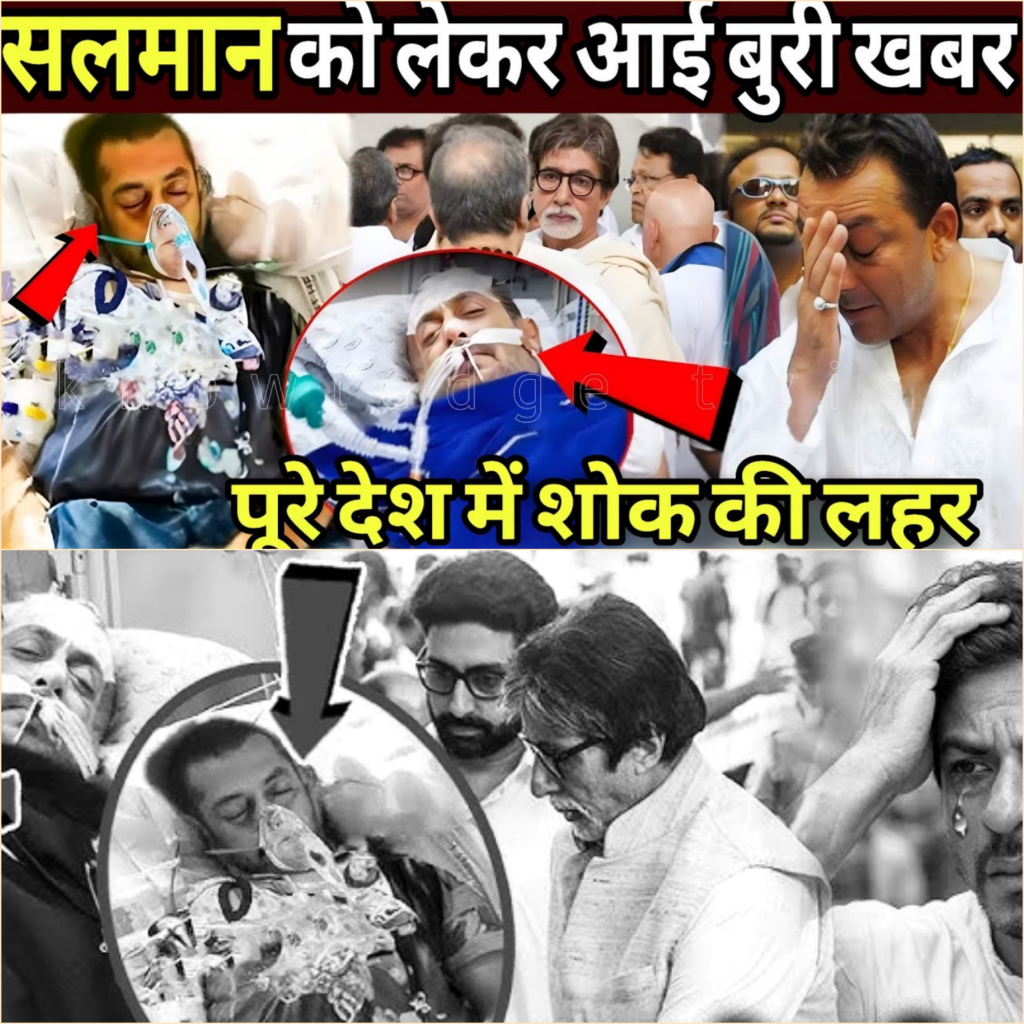
🔴सलमान खान को लेकर आई बुरी खबर || गंभीर बीमारी ने ली सलमान की जान || Bad
news about Salman Khan
.
.
.
Bad News About Salman Khan? Here’s What’s True, What’s Misleading, and What His Health Disclosures Actually Mean
Over the past few days, alarming posts and video narrations have spread online with headlines such as “Bad news about Salman Khan,” “serious illness took Salman’s life,” and other variations designed to shock viewers into clicking and sharing. Many of these viral clips mix genuine past statements by Salman Khan with exaggerated—and sometimes outright false—claims.
Let’s separate fact from sensationalism.
The key point upfront
There is no verified, credible public confirmation that Salman Khan has died. Any content claiming that a “serious illness has taken his life” is misleading unless backed by trustworthy, primary sources (official statement from family/representatives, major verified news outlets, or direct confirmation). Viral YouTube-style scripts often use dramatic phrasing to drive engagement, not accuracy.
That said, Salman Khan has publicly spoken in the past about significant health issues—some of them neurological and potentially serious. Those disclosures are real, and they deserve to be discussed responsibly, without panic-mongering.
What Salman Khan Has Actually Said About His Health (In Public)
The viral narration you shared focuses on three terms:
-
Trigeminal Neuralgia
Brain Aneurysm
Arteriovenous Malformation (AVM)
Salman Khan has indeed mentioned trigeminal neuralgia in interviews and public conversations over the years. He has also referenced having an aneurysm and an AVM, which are conditions involving blood vessels in or around the brain.
However, it’s crucial to understand what this does—and does not—prove:
It does indicate he has discussed medical conditions that can be serious.
It does not confirm an immediate life-threatening emergency.
It does not confirm “he can die any minute” as a certainty.
It does not justify rumors claiming he has already died.
Medical conditions exist on spectrums: severity varies widely, monitoring can be effective, treatments exist, and individual cases are unique. A viral script cannot substitute for a clinician’s evaluation or an official update.
Understanding the Conditions Mentioned (Plain English, Without Hype)
1) Trigeminal Neuralgia: “Electric Shock” Facial Pain
Trigeminal neuralgia is a chronic pain condition affecting the trigeminal nerve, which carries sensation from the face to the brain. It can cause sudden, severe, stabbing pain—often described as electric shocks—triggered by everyday actions like shaving, brushing teeth, speaking, or even wind on the face.
It can be debilitating and psychologically exhausting.
It is sometimes called one of the most painful conditions known.
Treatments may include medications and, in some cases, surgery.
Importantly, trigeminal neuralgia is not typically fatal, but it can dramatically impact quality of life.
2) Brain Aneurysm: A Weak Bulge in a Blood Vessel
A brain aneurysm is a weakened area in a blood vessel wall that balloons outward. Many aneurysms are small and unruptured and may never cause symptoms. Risk increases depending on size, location, growth, smoking, blood pressure, and other factors.
The greatest concern is rupture, which can cause bleeding in the brain (a type of hemorrhagic stroke). A rupture is a medical emergency.
But the presence of an aneurysm doesn’t automatically mean catastrophe is imminent. Many people live with monitored aneurysms, and some undergo preventive procedures when risk is judged high.
3) AVM: Abnormal Tangle of Blood Vessels
An arteriovenous malformation (AVM) is an abnormal connection between arteries and veins, bypassing the capillary system. In the brain, AVMs can carry a risk of bleeding depending on features like size, venous drainage pattern, and previous hemorrhage.
AVMs are complex:
Some require treatment (surgery, embolization, radiosurgery).
Some are monitored, depending on risk profile.
Outcomes vary widely from person to person.
Why Viral Content Turns These Terms into “He Will Die Any Moment”
Many viral scripts are built using a formula:
-
Start with an emotional hook: “The whole country is shaken.”
Use real medical words (aneurysm, AVM) to create authority.
Add a fear trigger: “It can take his life any time.”
Present work ethic as dramatic contrast: “Still doing stunts!”
End with engagement prompts: “Like, share, comment.”
The result feels like breaking news, but it often isn’t.
Even if Salman Khan has mentioned these conditions, it does not logically follow that he is currently in crisis—or that he has died. That leap is made for clicks.
“He Said It on a TV Show”—Does That Make It “Breaking News”?
The narration claims the disclosure happened on a comedy talk show setting (often referencing The Great Indian Kapil Sharma Show). It’s possible for celebrities to mention serious health matters casually on entertainment platforms, but two things matter:
Timing: a clip resurfacing in 2026 does not mean the statement was made in 2026.
Context: entertainment segments can compress, edit, or sensationalize.
Even when the celebrity’s words are genuine, the viral framing can be dishonest—making it sound like a current emergency rather than a past disclosure.
The Stunt Question: Should an Action Star Keep Working?
The narration repeatedly emphasizes that Salman continues to shoot action-heavy content, including stunts. In reality, large productions typically involve:
stunt doubles for high-risk shots,
controlled safety setups,
medical support on set (especially for major stars),
risk management by producers and insurers.
That doesn’t mean risk is zero—far from it. But it does mean “he is constantly at death’s door while jumping off buildings” is often an exaggeration.
A more balanced view is:
If a person has significant health concerns, decisions about work intensity should be made with specialists (neurologists, neurosurgeons, cardiologists), plus professional risk assessments on set.
Fans can admire discipline without romanticizing self-harm or ignoring safety.
Why People Believe These Rumors So Fast
Three psychological reasons fuel such viral “bad news” content:
-
Celebrity familiarity: People feel they “know” the star and react emotionally.
Medical terminology: Big words sound authoritative even when misused.
Platform incentives: Outrage and fear travel faster than corrections.
This is why misinformation about celebrity deaths and illnesses is a recurring internet pattern.
A Responsible Way to Talk About Salman Khan’s Health
If you want to report or discuss this topic ethically (as a news-style piece), stick to these principles:
Don’t state death or imminent death unless verified by reliable sources.
Attribute claims: “viral videos claim,” “he previously said,” “no confirmation available.”
Avoid medical certainty: no one online can estimate “how close” someone is to rupture or crisis.
Use the story to educate: awareness about symptoms and screening is far more valuable than panic.
Public Health Angle: What Viewers Can Learn (Without Fear)
If the viral discussion pushes people to learn about neurological warning signs, that can be a positive—if done correctly.
Seek urgent care for possible stroke/brain bleed symptoms:
sudden severe “worst headache of life”
sudden weakness/numbness on one side
slurred speech, facial droop
sudden confusion, vision loss, collapse, seizures
For recurring facial shock-like pain:
consult a neurologist—trigeminal neuralgia is treatable, but it requires proper diagnosis
Awareness saves lives. Rumors don’t.
Conclusion: “Bad News” Headlines Aren’t Proof—But His Past Disclosures Are Real
To summarize:
The claim that a “serious illness has taken Salman Khan’s life” is not something you should accept or share without verified confirmation.
Salman Khan has publicly discussed serious health issues including trigeminal neuralgia, and he has referenced aneurysm/AVM-related concerns.
Those conditions can be serious, but severity and current status cannot be determined from viral content.
The ethical response is caution, not panic; education, not sensationalism.
News

Doktorlar mafya babasının kısır olduğunu söyledi—bir garson ondan hamile olduğunu söyleyene kadar.
Doktorlar mafya babasının kısır olduğunu söyledi—bir garson ondan hamile olduğunu söyleyene kadar. . . . Chicago’nun karanlık ve acımasız yeraltı…
Tarihin En Acımasız Emri: 15.000 Esir Askeri Kör Edip Geri Gönderdi
Tarihin En Acımasız Emri: 15.000 Esir Askeri Kör Edip Geri Gönderdi . . . Karanlığın Yürüyüşü: Bir İmparatorun Soğuk Zaferi…

Köle Kadından Doğan Beyaz Çocuklar, Koca Bir Plantasyonu Nasıl Çökertti?
Köle Kadından Doğan Beyaz Çocuklar, Koca Bir Plantasyonu Nasıl Çökertti? . Köle Kadından Doğan Beyaz Çocuklar: Blackwood’un Çöküşü Güneyin yaz…

Bilim İnsanlarını Şaşkına Çeviren Çocuk: Elias’ın Vakası
Bilim İnsanlarını Şaşkına Çeviren Çocuk: Elias’ın Vakası . . . Bilim İnsanlarını Şaşkına Çeviren Çocuk: Elias’ın Vakası 1972 yılının dondurucu…

1997’de Sarıçöl’de Kaybolan Selim Karabey – 16 Yıl Sonra Bulunan Mataranın Sakladığı Gizemler
1997’de Sarıçöl’de Kaybolan Selim Karabey – 16 Yıl Sonra Bulunan Mataranın Sakladığı Gizemler . . . 1997’DE SARIÇÖL’DE KAYBOLAN SELİM…

Sıradan Bir Tokat, 20 Yıllık Sırrı Ortaya Çıkardı: O Adam Geri Döndü!
Sıradan Bir Tokat, 20 Yıllık Sırrı Ortaya Çıkardı: O Adam Geri Döndü! . . . Sıradan Bir Tokat, 20 Yıllık…
End of content
No more pages to load