ईट-पत्थर, बागेश्वर बाबा का पुतला जलाने पर भिड़े भीम आर्मी और हिन्दू संगठन! Bageshwar Baba Padyatra
.
.
Clash in Indergarh: Effigy Burning of Bageshwar Baba Sparks Violent Confrontation Between Bhim Army and Hindu Groups
Indergarh, Datia (Madhya Pradesh), November 2025:
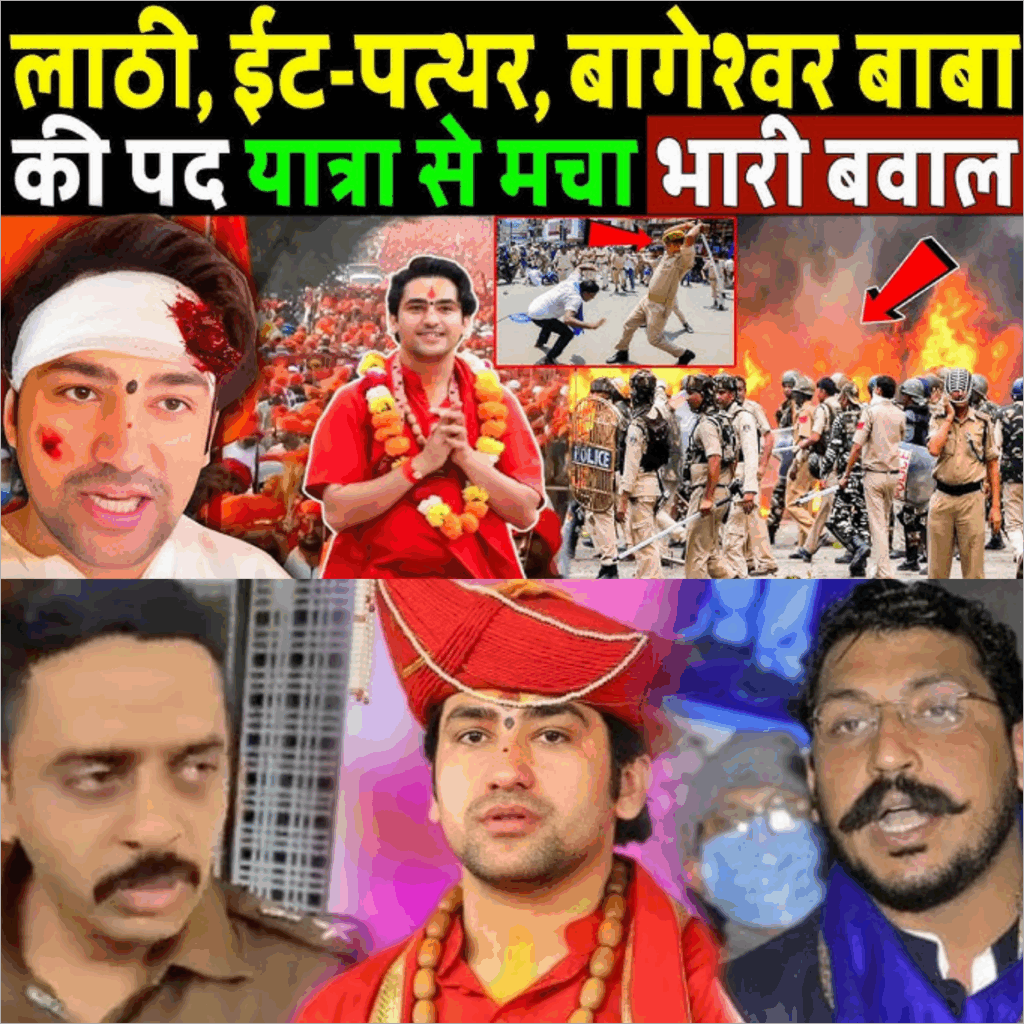
A small town in central India was transformed into a battleground on Saturday evening as a protest march escalated into a violent confrontation between Bhim Army activists and Hindu organizations. The catalyst: the burning of an effigy of Bageshwar Baba, a popular religious leader, by members of the Bhim Army and Azad Samaj Party. What began as a symbolic act of protest quickly spiraled into chaos, revealing deep-seated social and religious tensions in the region.
The Build-Up: Effigy Burning and Rising Tensions
Indergarh, a town in Datia district, is no stranger to political and religious activism. On this particular evening, the streets echoed with slogans as two opposing groups converged: supporters of Bageshwar Baba, representing various Hindu organizations, and hundreds of Bhim Army and Azad Samaj Party workers, waving their flags and marching in unison.
The Bhim Army and Azad Samaj Party had announced their intent to burn an effigy of Baba Dhirendra Krishna Shastri—known as Bageshwar Baba—at Gwalior Chauraha. The protest was in response to statements made by Baba during his recent “Sanatan Hindu Ekta Padyatra,” which some Dalit organizations perceived as offensive and divisive. While Baba’s supporters claimed his message was one of unity, critics accused him of undermining Dalit rights and stoking caste-based tensions.
The Protest Turns Violent
As the rally progressed from Ambedkar Park towards Gwalior Chauraha, the crowd swelled and emotions ran high. Slogans like “Baba Bageshwar Murdabad” and “End Caste Discrimination, All Are Equal” reverberated through the air. The atmosphere was charged, but few anticipated the violence that would soon erupt.
Before the rally reached its designated spot, someone set fire to the effigy of Baba Dhirendra Shastri. The rising smoke acted as a spark, angering the assembled Hindu organization members. They saw the act as an insult to a revered saint and responded with counter-slogans, including “Jai Shri Ram” and “Baba Saheb Amar Rahe.” The situation quickly devolved into chaos, as both sides began shouting and confronting each other.
The confrontation escalated rapidly. Stones and bricks were hurled, sticks were wielded, and the local police, already present at the scene, struggled to control the spiraling violence. Water cannons were deployed and lathi charges conducted in an attempt to disperse the crowd, but not before several people were injured and vehicles damaged.
Police Intervention and Aftermath
The violence lasted for nearly two hours. Three people were hospitalized with injuries, and several vehicles and shops suffered damage. The police called in reinforcements from four neighboring stations, and senior officers including the CSP and SDOP remained on site to prevent further escalation.
Both groups were summoned to the police station and given stern warnings. However, Bhim Army and Azad Samaj Party activists proceeded to the Indergarh police station, demanding that an FIR be registered against Baba Dhirendra Shastri. They alleged that his supporters had hurled casteist insults and disrupted their peaceful protest.
On the other hand, Hindu organizations insisted that Baba Bageshwar had always advocated for social unity and the eradication of caste discrimination. They argued that burning his effigy was a deliberate provocation and an attack on religious sentiments.
Social Media Erupts
As images and videos of the clash flooded social media, the incident quickly became a national talking point. Supporters of both sides shared clips and photos, fueling further debate and polarization. Some claimed that the growing popularity of Baba Bageshwar was intimidating political opponents, while others argued that religious leaders were being used to divide society along caste lines.
The district administration issued a statement confirming that the identities of the main participants had been established and that all necessary steps were being taken to maintain peace. Section 144 was imposed in the area, prohibiting public gatherings and rallies.
Local Community Reels from Shock
Shopkeepers in Indergarh closed their businesses as soon as the violence erupted, fearing for their safety. Residents described how the sudden outbreak of stone-pelting and fighting shattered windows and damaged vehicles. Many admitted that they had only seen such scenes on television before, but witnessing them firsthand brought home the dangers of unchecked mob violence.
Some locals blamed the police for not being sufficiently prepared, arguing that better vigilance could have prevented the escalation. The police, in turn, maintained that the situation developed unexpectedly and that they had no choice but to use force to restore order.
Political and Social Implications
What started as a protest over an effigy burning has become a flashpoint for broader social and political issues. Datia district, known for its sensitivity to religious and caste-based matters, has often been a microcosm of larger national tensions. The clash in Indergarh has exposed the fragility of communal harmony and the ease with which small incidents can ignite widespread unrest.
Some observers believe that the timing of the incident is not coincidental, coming as it does in the run-up to elections. There are suspicions that such issues are deliberately inflamed to polarize communities and sway votes. Others argue that the incident reflects genuine grievances and the need for dialogue between different social groups.
The Role of Baba Dhirendra Krishna Shastri
Baba Dhirendra Krishna Shastri, the spiritual head of Bageshwar Dham, is a controversial figure whose sermons and public statements have attracted both fervent support and sharp criticism. His recent call for a “Sanatan Hindu Ekta Padyatra” was intended, according to his followers, to promote unity and eradicate caste divisions. However, Dalit organizations felt that his remarks were dismissive of their struggles and reinforced social hierarchies.
Supporters of Baba insist that his teachings are inclusive and that he has always advocated for love and harmony. They argue that his growing influence is the reason for the backlash, and that burning his effigy is an affront to the values he espouses.
Bhim Army and Azad Samaj Party’s Stand
The Bhim Army and Azad Samaj Party, led by prominent Dalit leaders, have positioned themselves as champions of social justice and equality. Their protest was framed as a response to what they saw as casteist rhetoric and exclusionary practices. They maintain that their demonstration was peaceful until provoked by the opposing group.
Their leaders have demanded legal action against those who attacked their members and disrupted their rally. They have vowed to continue their agitation until an FIR is registered against Baba Dhirendra Shastri.
Community Leaders Call for Dialogue
Recognizing the gravity of the situation, the administration has convened a peace committee meeting, bringing together representatives from both communities. Local leaders have emphasized the need for dialogue, understanding, and reconciliation.
Many residents believe that only through open communication can the underlying issues be addressed. They point out that religious and political leaders are not above the values of humanity and that continued conflict only harms the community as a whole.
The Bigger Picture: Religion, Caste, and Politics
The Indergarh incident is symptomatic of a larger trend across India, where minor provocations can quickly escalate into major confrontations. The lines between religion, caste, and politics have become increasingly blurred, making it difficult to separate genuine grievances from manufactured controversies.
Social media has played a significant role in amplifying tensions, with both sides using videos and statements to rally support and demonize opponents. The ease with which information—and misinformation—spreads has made it harder for authorities to maintain order and for communities to find common ground.
Police and Administrative Response
The police have arrested several individuals involved in the violence and are investigating the incident. Section 144 remains in force, and patrols have been increased at all major intersections in Indergarh. The administration has promised strict action against anyone found guilty of disturbing the peace.
However, many locals remain skeptical, fearing that the issue will be politicized and ultimately forgotten. They worry that unless both sides sit down and resolve their differences, the underlying tensions will persist and potentially flare up again.
Lessons Learned and the Way Forward
The events in Indergarh serve as a stark reminder of the dangers posed by unchecked social divisions and the need for responsible leadership. As the town slowly returns to normalcy, there is a growing realization that real progress can only be made through dialogue, empathy, and respect for diversity.
Community leaders, shopkeepers, and ordinary citizens are calling for peace and urging all parties to focus on pressing issues like unemployment, education, and inflation—concerns that affect everyone, regardless of caste or creed.
Conclusion: A Community at the Crossroads
As Indergarh recovers from the violence, the town stands at a crossroads. Will it allow itself to be divided by religious and caste-based politics, or will it choose the path of reconciliation and unity? The answer will depend not just on the actions of leaders and authorities, but on the willingness of ordinary people to rise above their differences and embrace a shared humanity.
The clash over Bageshwar Baba’s effigy may have started as a small protest, but it has exposed deep fissures within society. It is now up to the people of Indergarh—and indeed, the nation—to decide how to heal and move forward.
.
News

Doktorlar mafya babasının kısır olduğunu söyledi—bir garson ondan hamile olduğunu söyleyene kadar.
Doktorlar mafya babasının kısır olduğunu söyledi—bir garson ondan hamile olduğunu söyleyene kadar. . . . Chicago’nun karanlık ve acımasız yeraltı…
Tarihin En Acımasız Emri: 15.000 Esir Askeri Kör Edip Geri Gönderdi
Tarihin En Acımasız Emri: 15.000 Esir Askeri Kör Edip Geri Gönderdi . . . Karanlığın Yürüyüşü: Bir İmparatorun Soğuk Zaferi…

Köle Kadından Doğan Beyaz Çocuklar, Koca Bir Plantasyonu Nasıl Çökertti?
Köle Kadından Doğan Beyaz Çocuklar, Koca Bir Plantasyonu Nasıl Çökertti? . Köle Kadından Doğan Beyaz Çocuklar: Blackwood’un Çöküşü Güneyin yaz…

Bilim İnsanlarını Şaşkına Çeviren Çocuk: Elias’ın Vakası
Bilim İnsanlarını Şaşkına Çeviren Çocuk: Elias’ın Vakası . . . Bilim İnsanlarını Şaşkına Çeviren Çocuk: Elias’ın Vakası 1972 yılının dondurucu…

1997’de Sarıçöl’de Kaybolan Selim Karabey – 16 Yıl Sonra Bulunan Mataranın Sakladığı Gizemler
1997’de Sarıçöl’de Kaybolan Selim Karabey – 16 Yıl Sonra Bulunan Mataranın Sakladığı Gizemler . . . 1997’DE SARIÇÖL’DE KAYBOLAN SELİM…
Sıradan Bir Tokat, 20 Yıllık Sırrı Ortaya Çıkardı: O Adam Geri Döndü!
Sıradan Bir Tokat, 20 Yıllık Sırrı Ortaya Çıkardı: O Adam Geri Döndü! . . . Sıradan Bir Tokat, 20 Yıllık…
End of content
No more pages to load